By Matthew Moorcroft
Strong Recommendation
- Directed by Aki Kaurismaki
- Starring Alma Poysti, Jussi Vatanen, Janne Hyyatianen, Nuppu Koivu
- Not Rated
This piece was written during the 2023 SAG-AFTRA strike. Without the labor of the actors currently on strike, the film being covered here wouldn’t exist.
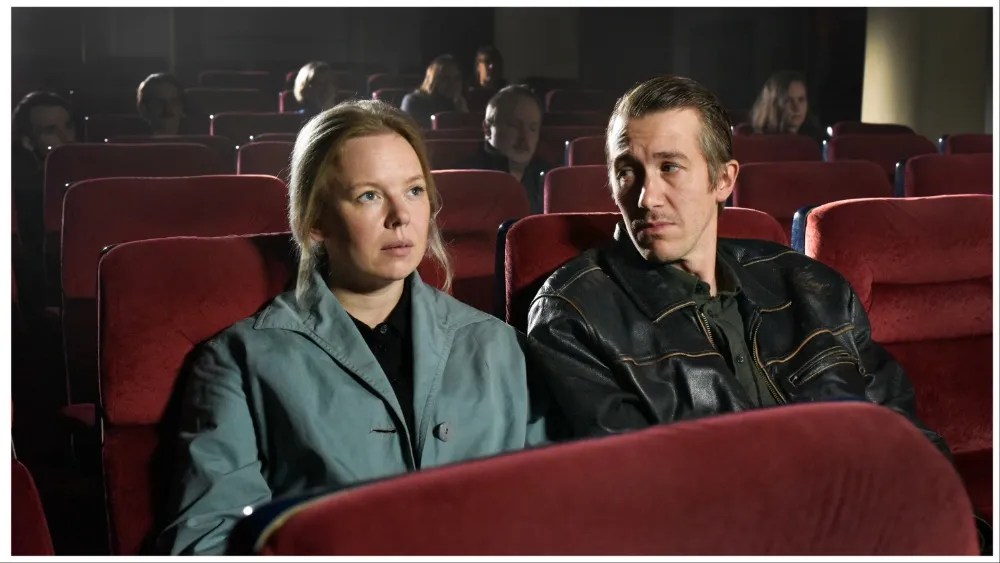
Aki Kaurismaki, the acclaimed Finnish auteur, really likes the working class. This feels like a random thing to say, especially since many a director find their sympathies among those who work tirelessly to very little, if any, actual respect among those at the top. But Kaurismaki, or at least the little I know about him as he is a director I know very little about personally, very much finds his situational work, particularly his characters, amidst the turmoil of everyday life. And after returning from a six year hiatus, Fallen Leaves almost feels like another call to solidarity after terrible events begin to befall the world one day after another.
The war in Ukraine likely affected Kaurismaki immensely, as the film opens with a news report talking about the early days of the invasion. We meet our two leads, one a supermarket employee who may or may not be stealing from the expired bins, and the other a construction worker who suffers a massive drinking problem, both of whom clearly feel trapped in a seemingly neverending cycle. It’s a chore to live, a chore to survive. And yet the booming of the death happening close by, almost next door as Russia is themselves at Finland’s gates in a way. You would think this means Fallen Leaves is as dour as dour gets, but far from it.
In fact, Fallen Leaves is immediately, and irresistibly, charming as hell, bringing you into it’s hyperreality almost right away and never letting go – if one finds themselves on it’s wavelength, that is. Said wavelength is one of sheer deadpan and seriousness that borders on hilarity, with characters so much as showing very little in the way of a smile. But when they do, it makes those moments all the more lovely and smile inducing, and Kaurismaki’s complete control of the camera allows these moments to be lingered on confidently like he’s been doing this all of his life.
Which he basically has. As a milestone 20th film from him, Kaurismaki has been told that he has made the “same film” every time but clearly he’s gotten very good at it over the years and knows exactly how to pull on your heartstrings. A scene early on, which involves karaoke, is both very funny – the constant gag about one character’s singing voice got consistent laughs – and also a great character meetup for our leads, whose trapped nature is emphasized in how they even feel constricted in their own leisure time. The only time they actually feel free is when they are together, when the space expands and there is room around them. It’s the subtle things that Fallen Leaves excels at, and it’s that attention to details that draws in your eye beyond the gorgeous aesthetic choices.
Those aesthetic choices might be among the film’s more bold decisions, as it’s ultimately an ambiguous time period that places it… somewhere. The film says it’s actually 2024, meaning it’s near future, but the war in Ukraine just started, and the technology feels old like it’s from the 50s or 60s in terms of it’s style. And the new release of the time is both Jean-Luc Godard’s classic Pierrot le Fou and Jim Jarmusch’s The Dead Don’t Die, both released in separate opposing time periods. The sense of place is warped, feeling both contemporary and timeless at once, both fantastical and modern.
What isn’t fantastical though is the crippling socio-economic anxiety present in this that feels all too real. For all of it’s mention of being a more developed country, Finland here feels almost like a fascist dictatorship in how it strangles it’s populace into working for their overlords. It’s impossible to ignore that, despite the film’s happy ending for the protagonists, that the job grind will likely continue. Who knows if Holappa, the male lead, will go back to drinking or not, something that was spurred by his job initially? That’s the questions it raises, even if subconsciously.
I’m glad Fallen Leaves does leave some kind of lasting impression, as in the moment it can feel mildly slight and a bit on the simple end. But this isn’t necessarily a knock against it, however, as the simple delights of seeing a couple fall in love (albeit in a weird, deadpan, very Finnish way) is more then enough in said moment. If anything, Kaurismaki is clearly a director I should have paid more attention to and found his work earlier, as it strikes a sensibility I didn’t know I needed. And if Oscar season comes around, this would definitely make a worthy entry for the Best International Feature category.
 Matt's Media Corner