By Matthew Moorcroft
Strong Recommendation
- Directed by Agnieszka Holland
- Starring Jalal Altawil, Maja Ostaszewska, Tomasz Wlosok, Behi Djanati-Atai
- Not Rated
This piece was written during the 2023 SAG-AFTRA strike. Without the labor of the actors currently on strike, the film being covered here wouldn’t exist.
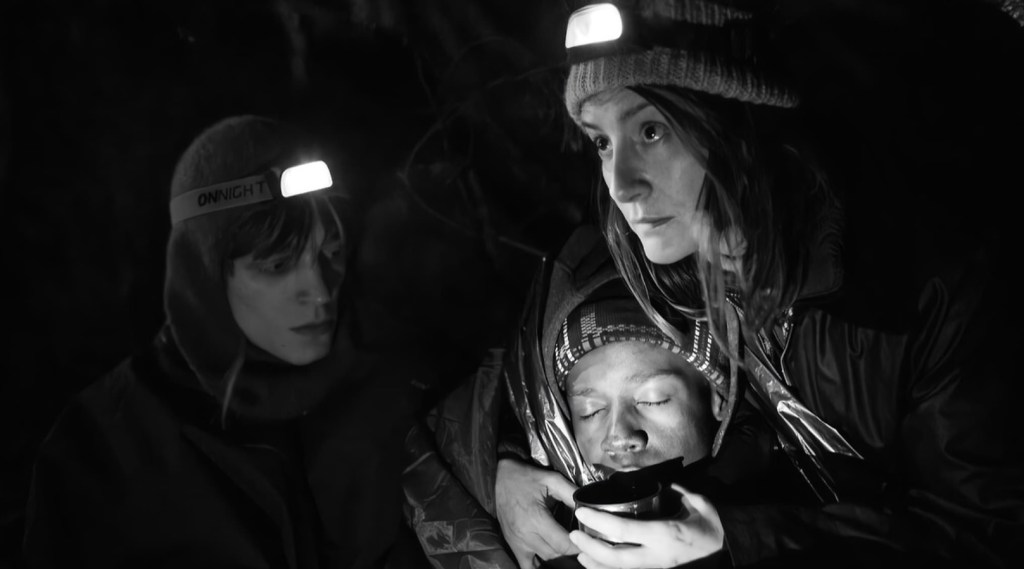
In the first 20 minutes of Green Border, we follow the perspective of a single family attempting to cross the Belarus/Poland border as a way to find some kind of safety. The Syrian family has been running for an undetermined amount of time, and they are soon joined by a Afghan woman who they take in with open arms. To those not in the know, it’s possible to believe that the starkly black and white film would be simply a rough, if ultimately hopeful, refugee story that peers international audiences into a world that they likely will never see.
But for those in the know, and those that have extensively followed the EU border crisis since it began, once the family enters Poland and then is immediately (and violently) sent back, it’s clear what’s happening. They are pawns in a game played with by people far more powerful then them, those that don’t care whether they live or die but simply only care about retaining any kind of power they have left. And in scenarios like this, it’s the disenfranchised, and the people who yearn to help them, that end up suffering the most.
The latest from socio-political activist disguised as a director Agniezska Holland, Green Border is beyond bleak – a sobering, difficult to stomach affair that will likely make the majority of viewers sick to their stomachs out of anger at the least, and the most possibly even radicalize. Holland’s persona within the Polish press – one of a “radical leftist” that wishes to destroy the country’s way of life – is one that seems almost impossible to believe after this, whose nuanced view of the migrant crisis gives the impression Holland is the only one who has actually knows what’s going on over there.
The four different perspectives here are all necessary ones too, as they give a complete picture of the brutality and neglect going on both from external and internal points of view. Holland’s critique at the systemic issues on both sides of the border are pointed yes, but she also has critiques leveled against ineffective countermeasures by some of the activists as well certain hypocrisies showcased at the end of the film (that one of the characters even calls out). The righteous anger on display is only compounded by the harshness with how it’s presented; each shot looks like a burnt out photograph that was taken in a war zone. It’s smartly approached with a modern digital look, which doubles down on Holland’s intention to make it almost documentary-esqe in inspiration.
It’s in Green Border‘s actual narrative structure that the real revelations are found, however. Holland purposefully disrupts the three act formula on multiple occasions, instead opting for a series of continuous escalation of stakes and characters that almost reflect the real life situation. It starts small enough, but eventually gets much bigger and out of their control as more and more complications enter the picture. And then it ends with the implication that this will go on for as long as possible if nothing is done – a stark, grim reality that Holland refuses to let you forget.
The constant grimness of the proceedings means that Green Border is less enjoyed and more so experienced. It’s not a film to be entertaining, hell it’s not even a film meant to be viewed. It’s a documentation of a specific point in history that could be otherwise forgotten and brushed aside, and for that reason alone it’s essential, important viewing. And one can hope that Holland continues her endeavors in delivering important social messages despite the attacks from the Polish far-right.
 Matt's Media Corner