By Matthew Moorcroft
Highest Recommendation
- Directed by Wim Wenders
- Starring Koji Yakusho, Tokio Emoto, Arisa Nakano, Aoi Yamada
- Not Rated
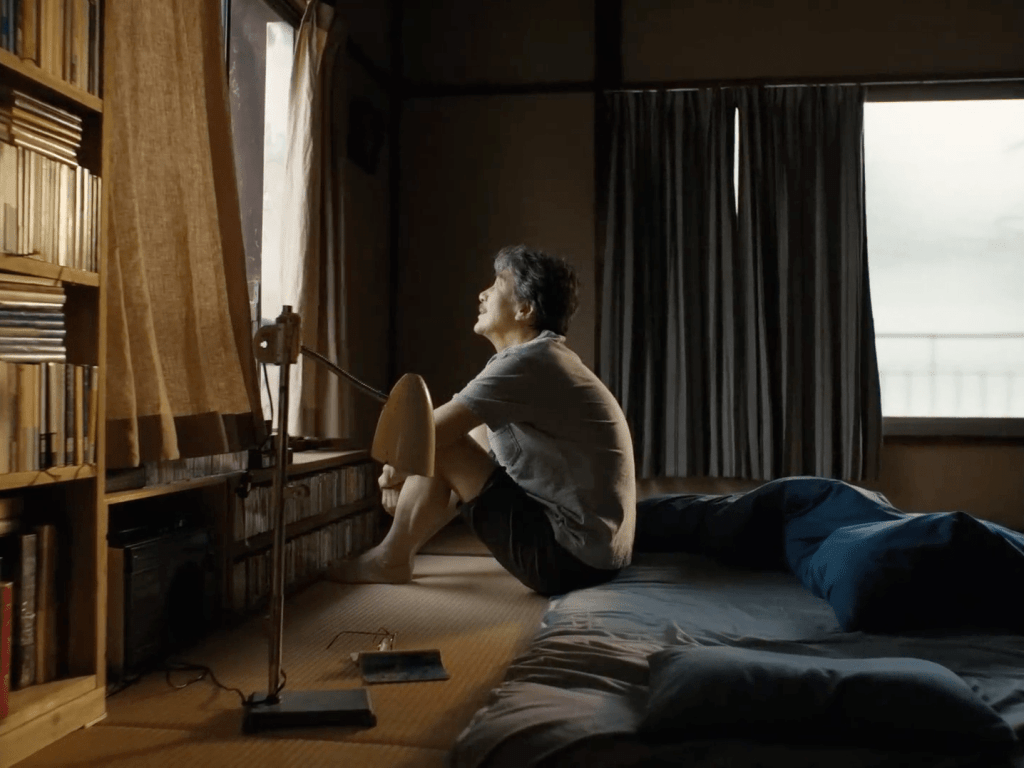
Hirayama is living his best life, seemingly. He wakes up early day in the morning, does his wake up routine, and then heads off to his job as a toilet cleaner while listening to music on his old cassette player. He meets new people on the daily, with some interactions brief while others are longer and more meaningful. He takes photos of the trees when eats his lunch, and takes care of them at home as well through bonsai. After work, he gets his favourite ramen, heads home, reads a new book on the weekly, and then goes to sleep. And the next day begins just the same.
On the surface, Hirayama’s life is nothing special, but the mundane nature of his existence is already intriguing and lets us in on the littlest things without saying much of anything. Wim Wenders, who has mostly been quiet on the film front for a little bit outside of a couple of projects, uses that seeming aimlessness that also defines his work and instead posits a question of “well, that aimlessness is beautiful, right?”. And as the title states, Perfect Days is very much that.
The real star of the show however is Koji Yakusho, whose presence in every frame of the picture allows for a complete embodiment of his leading protagonist. Much of his acting is without dialogue or reacting to what others say around him, and his facial acting doing much of the heavy lifting. It’s when in the few moments he does speak, usually only with purpose, that you realize that there is much more going on underneath the surface of the man then simply somebody who finds beauty in the small patches of life. Perfect Days is ultimately a character study of one such a person, and questioning why they do what they do without judgment. It’s implied Koji switched over to this job recently, or at least was doing something else for a while. What was it? We don’t know exactly, but we can only see him through this lens. It’s impossible to see him anywhere else, and that’s part of his charm.
Wenders manages to keep the lax, almost quiet tone of the piece afloat without it ever dipping into downright repetitivity or boredom. It’s a delicate balance, and Wenders even allows for some wit and light-hearted banter to keep things interesting. Wenders isn’t exactly known for his “light” affairs but Perfect Days is one of his most calm and collected, seemingly more dedicated to his love of photography then anything else. The dreamlike compositions that mark the changing of days feel like our lead contemplating every day that’s given to him, finding some kind of meaning in his slow, calculated existence.
And then the last act and suddenly things start to click into place. His niece arrives, and you learn more about his home life prior to him living alone. There is a longful look at a woman that he can’t have, or just doesn’t have the courage to admit to. A slow acknowledge of the creeping march of death that will one day consume us all. Is Wenders grappling with his own mortality now that he is nearly 80? Or is he simply looking back at his life and passions and reflecting on the smaller, more keen moments. I keep bringing up Wenders over Hirayama cause while yes, Koji Yakusho is truly remarkable here, it’s ultimately clear to me that Hirayama is a stand in for Wenders himself. If the love of photography didn’t give it away, it’s the fact that his music of choices happens to be similar choices to Wenders’ own personal tastes, and Wenders’ love of Japan as a country would explain the decision to have this be a Japanese production.
It definitely took me a little bit to vibe completely with Perfect Days, especially since it’s slow pace in the first third means that the first major thing to happen is as small as “my co-worker’s girlfriend shows up to work one day”. But once that vibe hits, Perfect Days is, funnily enough, as perfect as they come. It’s Wim Wenders at the height of his abilities creating something that feels both relaxing yet ultimately personal, and that alone makes it worth a check out even if one isn’t completely on board for it’s more eccentric tendencies at points. Stellar film, and one to watch come awards season.
 Matt's Media Corner