By Matthew Moorcroft
Strong Recommendation
- Directed by Sofia Coppola
- Starring Cailee Spaeny, Jacob Elordi, Dagmara Dominczyk, Lynne Griffith
- PG-13
This piece was written during the 2023 SAG-AFTRA strike. Without the labor of the actors currently on strike, the film being covered here wouldn’t exist.
I never got a chance to officially review Baz Luhrmann’s Elvis from last year, mainly due to traffic reasons as I tend to stick to festival screenings and theater screenings for things I properly discuss here. That being said, I did manage to catch it prior to the Oscars earlier in the year and as a long time for Luhrmann I found it exactly what you would expect from an Elvis movie by him – extravagant, wild, and camp in the best way possible, if also slightly overindulgent, over the top, and impossible to take seriously. It’s elements are a feature, not a bug.
I bring this up cause it’s impossible to discuss Priscilla, Sofia Coppola’s latest affair that was very likely made as a response to Luhrmann’s film, without discussing the elephant in the room about Luhrmann’s initial biopic, which is the age gap/groomer relationship that was the marriage between Elvis and Priscilla Presley. The thorny subject already gets people heated and argumentive as people debate on the specifics years on out, and Coppola’s seeks out to see a different perspective away from the numerous male ones in favour of one so little listened to – Priscilla herself. Despite it being her marriage and her life, Priscilla’s story about her ill-fated relationship very rarely gets brought into the conversation, instead surrounded instead by myths about the man in the house or conversations about her post-marriage acting career. As Coppola’s film so earnestly, and quickly, shows, Priscilla’s story is the key to the whole affair, the key component that’s required to truly dissect this complex web.
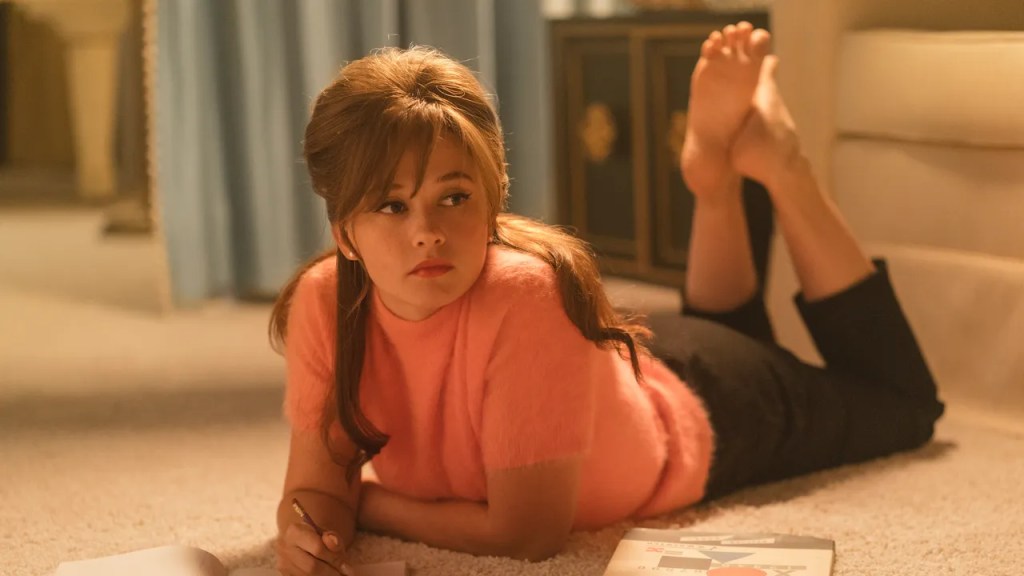
When we first meet Priscilla, she is young, almost impossibly so. The impeccable Spaeny, who gives a star making turn here, both looks and sounds like she is a child, making the uncomfortable nature of what is happening brought to the forefront. Elordi just towers over her, his giant stature both adding to the initial awe that she has and then the eventual frightened state that she laid in for much of her marriage. It’s a dynamic built almost entirely on visual blocking and cues, as the dialogue indicates very little about Elvis’ intent. And why should it? Anyone should be able to pick up on the insidious nature of the relationship rather quickly if they are paying attention.
“She’s mature for her age”. “It’s still in high school”. “She looks like a kid”. These lines are everywhere in the first half of the picture, but it’s without self-reflection on the part of the people around Priscilla, who simply loan her around to Elvis without a second thought. And once the second half starts, with her officially living with him and getting married to him, the isolation begins and the outside world almost becomes a blur. All we see are the pink walls, the gates, the adoring fans outside, and her constant worries about Elvis’ possible infidelity (which Coppola wisely decides to leave a definite answer on whether or not they did happen). It’s a mental hellscape, an endless prison where her agency has been stripped away from her bit by bit and now she feels trapped and helpless.
The decision to make Priscilla’s first real act of agency – the divorce from Elvis – the climax of the picture is an interesting one for a variety of reasons, but ultimately Coppola clearly wants the story to be about giving women some kind of agency. Once she leaves, Priscilla began doing what she wanted to do for the first time in her life, and the rest of it is “she lived happily ever after”. A ballsy choice, especially considering the divorce proceedings for the two were, both in this film and in reality, rather quick, painless, and surprisingly cordial, but one that fits into Coppola’s oeuvre rather well.
Coppola’s patient, gorgeous, and textured direction allows this to pop out with every frame, with the beautiful costume work and production design leaping out on screen. Coppola is consistently at her best when she gets to work with the mix of lavish on screen imagery and the lonely, sad figures that inhabit them, and Priscilla is up there with Marie Antoinette and Lost in Translation in that regard. Every shot looks like something from a painting that somebody found from the era, and while the lack of actual Elvis music is likely licensing related (not surprising considering the subject matter of the work), the actual music here, done by a variety of artists mimicking the sounds of the period and Elvis’ own music talents is a smart choice to help remove that barrier.
If Priscilla has one failing to it, it’s ultimately that, amidst Coppola’s surefire direction, the two magnetic lead performances at the front, and the lushish, grand look of the production, there is zero new information here that you can’t easily find on Google or Wikipedia, which is the standard issue with many biopics like this. Especially when compared to Oppenheimer from earlier in the year, which used it’s subject and biopic nature to create a full on sensorial experience, Priscilla plays it much more safe, and this is more clear once the third act hits and it almost rushes through some portions of the story – mainly things that were more extensively covered in Luhrmann’s film.
And going back to Luhrmann’s film, it’s possible that the two films are now impossibly linked – a double lengthed, 4 and a half hour portrait of one of the most legendary figures in recent American history. While some will gravitate to Luhrmann’s extravagance, I find himself increasingly on the side of Coppola’s Priscilla and how it handles it’s subject matter. It’s a major piece of work from her despite some small nitpicks, and if history will remember Coppola for anything I hope it’s for reclaiming the name of Priscilla Presley not as the wife of Elvis Presley or as the victim of Elvis Presley, but as simply that – Priscilla.
 Matt's Media Corner