By Matthew Moorcroft
Highest Recommendation
- Directed by Martin Scorsese
- Starring Leonardo DiCaprio, Robert de Niro, Lily Gladstone, Jesse Plemons
- R
A near 10 year in the making picture, Killers of the Flower Moon represents the third in a trilogy of late period Martin Scorsese projects that are mainly passion affairs. It started with his faith based masterpiece Silence and continued with his long awaited return to the gangster genre in The Irishman, both films that took something of upwards of a decade or more to make for various reasons and cost quite a bit of cash upfront to do. And while Killers of the Flower Moon didn’t take nearly as long as those films did, it’s production was somehow even more frantic, not helped by the onset of the pandemic and a constantly changing script that eventually morphed into a film more focused on the Osage peoples then the rise of the FBI story it was initially pitched as.
Never doubt Scorsese though, as Killers of the Flower Moon is, probably expectedly, phenomenal; a towering work of American cinema that is essential viewing, a sobering portrait of what happened and what continues to be ignored. I don’t think there is anybody in the business more concerned with media literacy and how film can influence entire movements more then Scorsese, who has found this opportunity to take what would otherwise be yet another crime epic (albeit one of a story that has been undertold) and turn it into a rallying cry for those that have been forgotten, a funeral march for the victims.
Our subject is the early 1900s. The Osage people have found oil on the reservation that they themselves were forced on, and suddenly their white guardians are oh so interested in them. As rich as the Osage get – it is oil at the turn of the century after all, you will become rich – they are still controlled by the forces in power, being told what they can and cannot buy, when they can and cannot withdraw, and when they can and cannot use their funds. They may have stability, but they have no control. It’s white supremacy in action.
And then people start dropping dead, seemingly from illness or suicide, but anybody with half a brain can figure out that there is something far more sinister going on. After all, the Osage people marry into white families, and then they die, leaving the inheritance for their “benefactor” to reap the benefits. It’s so obvious what is going on that once the investigation does start nearly over two hours into the massive 206 minute long feature that the head agent figures it out almost immediately. Yet nothing was done, cause nobody cared or this is what America actually wanted in the first place.
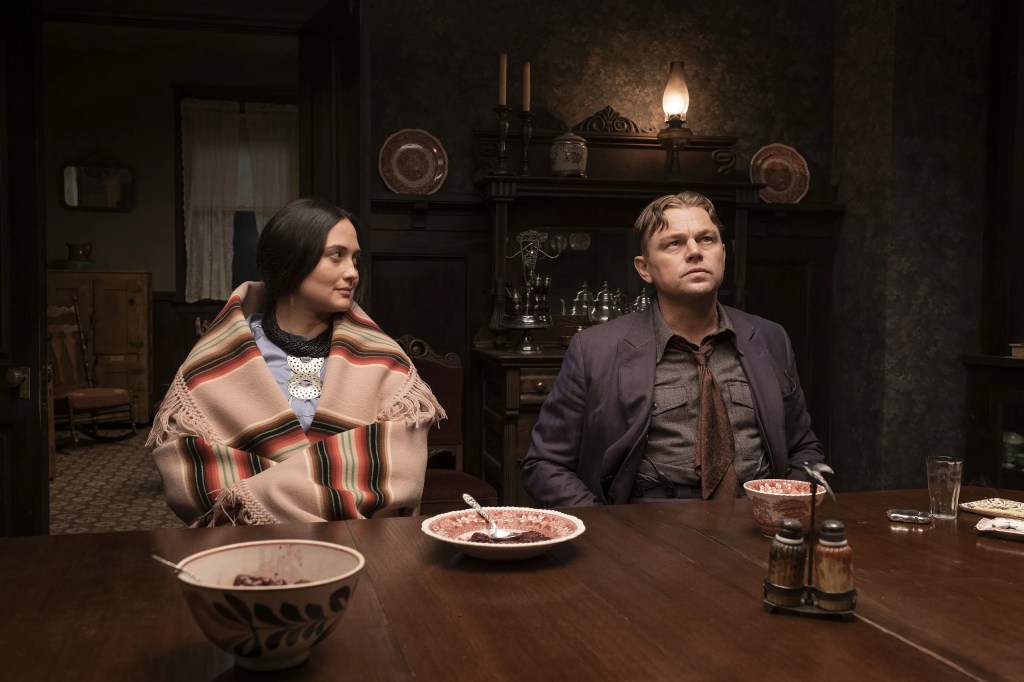
It would be almost cartoonishly evil if it wasn’t also exactly what happened, and because of that Scorsese always makes sure to remind you of the depravity on display here. De Niro is so slimey here, playing an antagonist that uses the façade of allyship to further his own agenda while seemingly having nothing but contempt for everybody he deems beneath him. He slowly transforms from a gentle father figure to a terrifying force of nature over the course of the film, almost at the same speed as Ernest begins to see him. And while DiCaprio has to tow the line between being reprehensible and somewhat sympathetic (but not enough to be wholly redeemed), he manages to keep that line blurred wonderfully. He’s a doofus, and it makes the fact he was able to get away with something like this all the more infuriating.
This is really Lily Gladstone’s picture though. With a nary so much as a simple glance, Gladstone is able to say so much, reclaiming this story as about her and the struggles that she goes through in the name of her people. Her work here is subdued and requires the audience to pay attention, but that’s the beauty of it; by the time she is no longer around, you take her for granted and you realize the hole that has been left in the film and by likewise the actual story, which is the point.
And from Scorsese’s continued attention to detail – this is just an immaculately crafted picture from top to bottom – and Thelma Schoonmaker’s basically nigh perfect editing work, this is as engaging and mesmerizing a film this length can be. Not a single frame is wasted, and the long length of the picture ensures that the massive scope of the events is felt. The end, which is less of a grand climax and more of a slow unraveling of psyches, has a fascinating final sequence that almost feels like Scorsese grappling with his own mythos; the art of cinema and storytelling itself cannot simply begin to comprehend the staggering tragedy that occur in the Osage Nation.
Pretty amazing in general that Scorsese is pumping out career best work this late in his career; a picture so vital to understanding his own oeuvre and yet it comes so late into his filmography. And once it’s done, you feel the culmination of an entire artist’s life poured onto screen, even if you know in the back of your mind he will be back with more. If this was the final film from the master himself, I would confidently say I am satisfied. But it won’t be, and for that I’m thankful, as I want Scorsese to continue making films as long as the human race is still around. Brilliance.
 Matt's Media Corner