By Matthew Moorcroft
Solid Recommendation
- Directed by Mike Mitchell
- Starring Jack Black, Awkwafina, Dustin Hoffman, Viola Davis
- PG
It’s been 16 years since the original Kung Fu Panda dropped in 2008. The surprise box office smash and critical darling was almost as important as the moving parts behind the scenes during it’s production. DreamWorks, hiding high off of the success of the Shrek franchise and several other high profile features, used this opportunity to start experimenting beyond the comedy heavy affairs that their filmography became known for. And while Kung Fu Panda may have started life as a parody much like their earlier work, it’s evolution from farce to genuine wuxia film with comedic elements showed something truly special in what was otherwise a throwaway concept.
Much time has passed since then though, and times have changed. DreamWorks has, internally become a shell of what it once was despite slowly recovering it’s prestige thanks to efforts like the fan favourite The Bad Guys and the critically acclaimed Puss in Boots: The Last Wish. Constant internal regime changes, a buyout, and eventual shuddering of main studios ensured that the DreamWorks Animation of today become a different company then the one that created the original film. Both prior sequels still managed to come out fine – particularly Kung Fu Panda 2, which has gained a very just reputation for it’s high quality – but for Kung Fu Panda 4, the first film in the series without the involvement of the true series auteur Jennifer Yuh Nelson, it’s a genuine test of will.
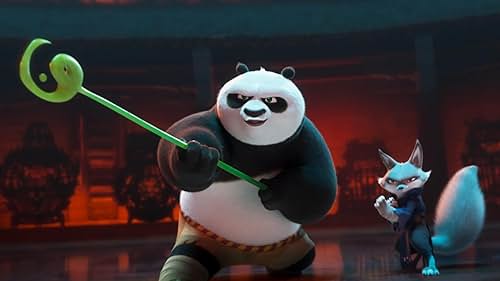
So the fact it’s even still passable, let alone enjoyable, is pretty remarkable. Kung Fu Panda 4 is nowhere as good as the original trilogy – it’s nowhere near the first two films in terms of quality and even lacks 3‘s strong thematic direction – but it still manages to pack a visual panache all it’s known and doubles down on the action sequences that have become a franchise staple. Mike Mitchell’s mission plan for this sequel was clearly as faster and leaner sequel, and while that frantic pacing gives it an occasionally messy feeling it also means the lesser stuff is moved on from quite quickly and the good can be rapid fire. The mile a minute jokes and dialogue is initially overwhelming but once the groove is found at the halfway point it’s off to the races.
The voice cast is the highlight as per usual here, who all fit back into their roles like glue. Jack Black’s infectious energy and love for the franchise has been evident as early as the first film, but he’s got it back in spades here and continues crafting Po into one of animation’s great lead protagonists. A character not defined or restricted by his flaws but also doesn’t ignore them either, managing to craft equally great comedy and drama out of them (though in this case mostly comedy, with the drama being more low stakes then usual for the series). Dustin Hoffman’s brief reprisal is as fun as expected, and the consistently reliable James Hong has been a scene stealer since the first film and that continues here. Hong himself being paired up with a back in comedic form Bryan Cranston for the majority of the runtime is a genius choice as well, as it gives to much of the film’s stronger moments both comedic and narratively. And while underused, Ian McShane’s highly anticipated return as Tai Lung is both as menacing as expected along with being shockingly hilarious as McShane plays up Lung’s more childish side in the third act to great effect.
But it’s always in the villain side of things that Kung Fu Panda has made a name for itself, and while Viola Davis’ The Chameleon lacks the same level of sophistication in their backstory like Lord Shen or Tai Lung, she fits in with General Kai’s oeuvre as an immediately great design and concept. And in that note, other new character Zhen, played by the always divisive and yet always talented Awkwafina, gets lumped in there as well… at least until the third act, where her role becomes more interesting and she immediately jumps out as the MVP of the dialed down, sadly Furious Five-less sequel.
And I think that’s ultimately going to be a breaking point for some in the audience. Kung Fu Panda 4 is indeed smaller scale in not just it’s story and scale but also it’s production – it’s low budget apparent at points, particularly in some of the more dialogue heavy scenes. And while the action sequences are as show stopping as ever in terms of animated prowess, and the trademark visual beauty of the franchise does creep in during these segments, the mark of a troubled production is everywhere here. In hindsight, it should have been obvious something was awry – no trailers till 3 months till release, last minute release date, and script rewrites galore meant something was up – but recent revelations in the press have turned Kung Fu Panda 4 into a miracle in that it got made at all.
It’s tough to say if Kung Fu Panda 4 will spell the final adventure for our beloved panda friend. It’s likely it won’t – the series too popular and at this point financially successful to maybe ever end – but as another stand alone installment it’s quite solid, if ultimately lacking in meaningful substance. Definitely worth checking out if you are fan, though don’t go in expecting a film on the level of 2.
 Matt's Media Corner