By Matthew Moorcroft
Weak Recommendation
- Directed by Pablo Larrain
- Starring Angelina Jolie, Pierfrancesco Favino, Alba Rohrwacher, Kodi Smit-McPhee
- R
Pablo Larrain’s trilogy of women centric stories (unofficially and unwiedly called “Trilogy of important 20th century women”) is mostly defined by two very key ingredients. Firstly, each film is less of a straight up biopic and more of a tone poem, highly interested in replicating a particular feeling or emotion rather then telling a biographical story. And secondly, they are confined usually to only a couple of locations – they are ultimately chamber pieces with a small amount of characters and a heavy focus on interior locations over the outside world. Our women feel trapped and languished, whether it be due to trauma, fear, or in the case of his newest Maria, self-doubt and alienation.
And it makes sense that Maria Callas would be his final subject here. Both Jackie and Spencer focused on royalty, and Maria is royalty in a way, although a much different kind of royalty. While Jackie Kennedy was certainly political royalty and Princess Diana literal royalty, Maria Callas is musical royalty – the kind of singer that achieves mainstream levels of fame around the world beyond their initial niche. Even if you don’t know opera, you likely know Maria Callas or even have heard her, with her voice as iconic and possibly moreso then the women herself. But what happens when you lose that voice? What happens during the very real possibility you lose exactly what initially makes you famous and now you are stuck in a hell of your own self-reflecting and self-hatred?
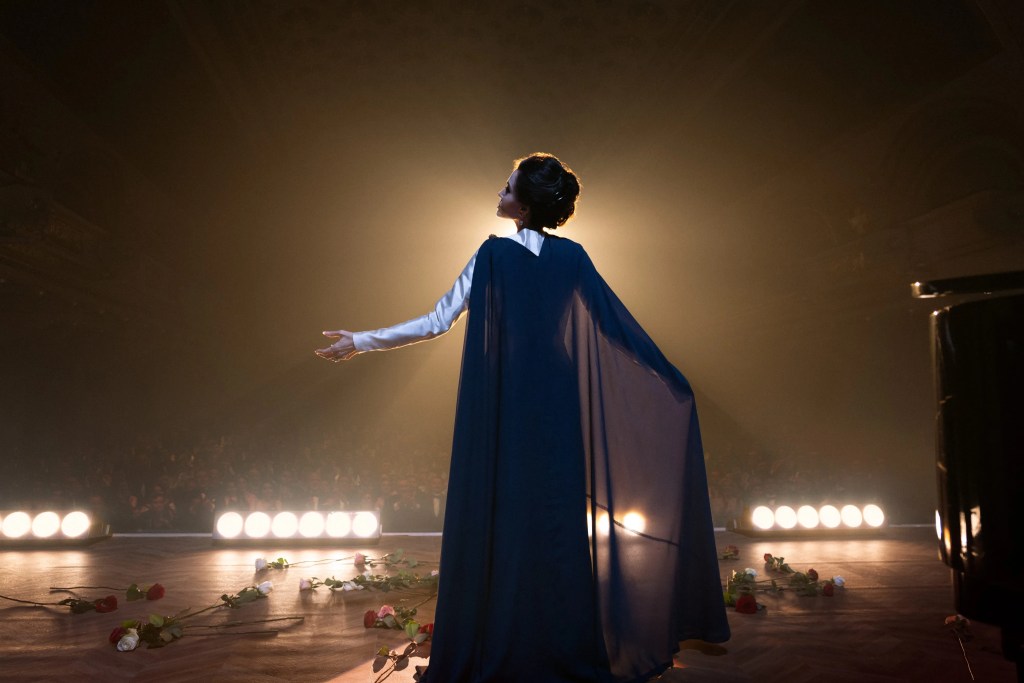
With Angelina Jolie up to the task here, Maria is certainly well crafted. It’s utterly gorgeous as per expected by Larrain’s careful, precise direction and Ed Lachman’s usual phenomenal tableaus. Much of the success of these films by Larrain has been the balance between his own personal style – that of a craftsman slowly weaving a basket of ideas that merge together to create something truly beautiful – and the powerful lead performances at the helm, and Jolie is magnificent in embodying the late stage Maria Callas. She never plays her too unsympathetic or unrelatable, but also doesn’t veer into complete “woe is me” territory either; Jolie’s Maria is a complex figure with vices that she clearly doesn’t want to overcome, and a victim complex so large that threatens to overtake her. But it’s all beautifully humanistic, and Jolie’s final act as the character is some of her all time best work as a performer on screen.
It’s a shame then the rest of the film, for as gorgeous as it is, really never quite hits the same level as her. Maria feels like a bag of tricks that we’ve already seen before; the interview esqe structure and the almost claustrophobic nature of the set is ultimately a repeat of Larrain’s prior work. It seems to want to double down on being a full on psychological dive deep instead, complete with dream sequences and psychosis, but that stuff isn’t in the movie nearly enough to justify itself and seems to more exist as a way to try and give exposition to a fictional journalist named Mandrax. You can absolutely guess where that is going and what that’s about.
I would probably be more positive about Maria if it seemingly had anything interesting to actually say though, but unlike Jackie‘s sobering portrait of grief in the wake of tragedy or Spencer‘s almost horror movie take on being at a party with family you don’t like, I’m struggling to figure out what exactly Maria is all about. I do appreciate it’s melancholic tone and vibes, but if it’s all in service of what is essentially “Sad: The Movie” then it’s fake meat; all of the texture of the real stuff but none of the actual juice.
But also I can’t say I didn’t enjoy Maria. Pablo Larrain continues to be too extravagant and genuinely interesting of a filmmaker to be anything but, and Angelina Jolie’s turn is so good that it almost completely saves the picture from being mostly just fine. But as it stands, it’s a clear weak spot in a trilogy that has otherwise been a really great examination of Larrain’s personal interests. Definitely recommend for those who like his stuff, but for those on the fence – stick with Jackie or Spencer.
 Matt's Media Corner