By Matthew Moorcroft
Strong Recommendation
- Directed by Brady Corbet
- Starring Adrien Brody, Guy Pearce, Felicity Jones, Joe Alwyn
- R
Made for only $9.6 million, The Brutalist feels like a towering feat. It is in itself a statement; a huge, monumental picture that feels huge and monumental while only using a fraction of the resources that is normally given to a feature like this. Very fitting that a film about construction itself – an architect going out of his way to create a massive project for a wealthy client – is obsessed with the way it too is constructed and presented. Film is like a jigsaw puzzle; find one piece and it all either falls into place or becomes unsolvable.
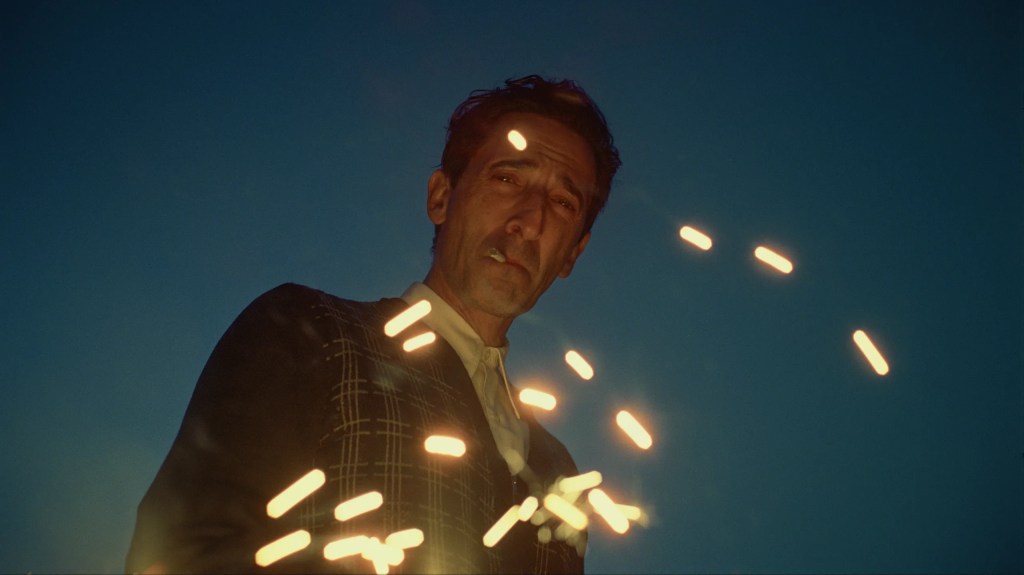
I should love The Brutalist. It’s exactly the kind of film I’ve been begging to see more of in theaters – while I love blockbuster genre fare, low budget horror, and star laded rom-coms, The Brutalist feels like a film that comes from the 70s with it’s grungy look and auteur driven vision. Even the cameras of the picture are in of themselves from a different time, going back and embracing the long forgotten VistaVision format that hasn’t been used since 1961.
Frankly, it’s heresy to say that I only merely thought The Brutalist was “really great” as opposed to the best thing I’ve ever seen cause it feels like one of those films that destined to future greatness. However, just like 2022’s Babylon, another film which I found to be a towering if flawed epic, The Brutalist feels right after the moment to be difficult to connect to. It’s a film about one very specific thing and hammers it over with you like a brick for over three hours, but it also is an intimate character study, an examination of post-war America, a showcase of technical prowess, and a discussion about the circumstances surrounding much of our current cultural landscape.
For much of the first half, this all succeeds with flying colors. The remarkable score which envelops much of the film keeps things moving at a surprisingly brisk pace, and Brody’s magnetic performance as Laslzo Toth is at center frame the whole way through. And once he’s paired up with almost unrecognizably good Guy Pearce – giving what might be the performance of his career – you are on high heaven. Laslzo is a man searching for the fabled American dream in the wake of tragedy, and those first frames, seeing the Statue of Liberty overhead in frame out of the darkness, briefly makes you believe in it.
And while it’s obvious The Brutalist will take down that myth, it’s impressive on how slowly it decides to play it’s hands. Instead, you are sucked into the slow build of domino pieces getting into place, running to come crashing down at any second. Once that second half hits, it’s really where the domino pieces begin to fall at a rapid pace. The moral rot and domination of capitalism becomes personified through action here, and Laslzo’s own creation becomes an obsession turned into performance art out of his contorl.
It’s a shame that it’s also the more somewhat messy, maybe overly self-indulgent part of the picture. While Felicity Jones, possibly the real standout of the cast, gets a lot to do here as she shows up at the halfway point, it becomes clear that Corbet as a director is less interested in his cast as people and rather just vessels for theme and story. Brody’s character begins to lose agency – perhaps a necessary evil to show America’s grip on his identity tightening – and Pearce basically loses his three-dimensional qualities. It’s a bizarre shift from the exceptionally textured and enthralling first half that never fully gels with itself.
Hard to complain though when it still looks amazing. Even when The Brutalist slightly loses it’s way thematically by the end – that final scene is a real doozy – it never stops being immensely satisfying on a pure artistry level. From the vistas of Pennsylvania that suddenly look like old photographs to stunning wides of trains travelling vast distances, every frame of the film looks like it could be placed in a museum and you’d be right for it.
That final scene though I think it really where the sourness begins to set in. Unlike most, I think it’s pretty clear what Corbet is going for here – in the end, even Lazlo’s own daughter is using his construction as a way to push her own agenda, or at the very least is making assumptions about it that were possibly never intended. But Corbet also frames it in a way that is thematically all over the place, and the switch to digital cinematography is jarring. Less salvageable is the (possible) usage of AI in the final sections of the picture, which is mostly indefensible.
I think The Brutalist is destined to be appreciated and loved by me on a pure technical level over a narrative one. The more I ponder it and it’s ideas I find myself gravitating more towards the smaller moments in it’s narrative over the bigger picture. The grand story about the building of a single large monument is something I can take or leave, but the story of a man who loves his wife so much he’s willing to sacrifice his own dreams to help her recover the best he can? That’s the kind of stuff I live for, and ultimately I think the The Brutalist has more then enough of that to get the full marks from me. A reluctant 5/5 picture for craft only, but just barely.
 Matt's Media Corner