By Matthew Moorcroft
Highest Recommendation
- Directed by Paul Thomas Anderson
- Starring Leonardo DiCaprio, Sean Penn, Benicio del Toro, Chase Infiniti
- R
The chance to review a new Paul Thomas Anderson flick is something of a rare opportunity. One of the greatest living American filmmakers – maybe one of the last if AI seemingly has it’s way within the studio system and beyond – and one of our best living auteurs, Anderson is almost doing something interesting with his material in ways that are distinctly unexpected. Whether it’s using a legendary actor’s final role to almost deconstruct him metatextually in Phantom Thread, using coming of age romances tropes to present a hyper reality of two people trying to be something they aren’t in Licorice Pizza, or just basically everything about Magnolia, he is a filmmaker that demands your fullest attention every single time.
Honestly then what’s unique about his latest, the ambitious and expensive One Battle After Another, is how actually straight forward it is compared to his other work. While there are layers of meat to be found within it’s borders, One Battle After Another plays much more like a crowd pleasing blockbuster; a movie with clear cut heroes and villains, action sequences that rock your socks off, and great dialogue that rotates between strong emotional hooks and witty banter so effortlessly that it becomes a magic trick. It’s also one of his most grounded films yet as well, eschewing some of the more purposefully hyperrealistic aspects of his prior films for something a little more on the ground then expected from him.
Though considering it’s subject matter, I don’t think it really needed to stretch far from the truth here. One Battle After Another has it’s shoes firmly planted in the now, which is a time of history that almost feels like itself the beginning to a dystopian thriller. Immigrants are being locked up in cages on a regular basis, the police are militarized, and anybody who is trying to say something feels like they have a target on their back the whole time. One Battle After Another‘s conceit – the idea of political violence as a necessary evil in the wake of fascism, oppression, and rising creep of a police state that is slowly getting too powerful for it’s own good – gives Anderson plenty of wiggle room here to not even have to try to be absurd for the sake of being a movie. Real life has become the absurd, Anderson is just now it’s messenger.
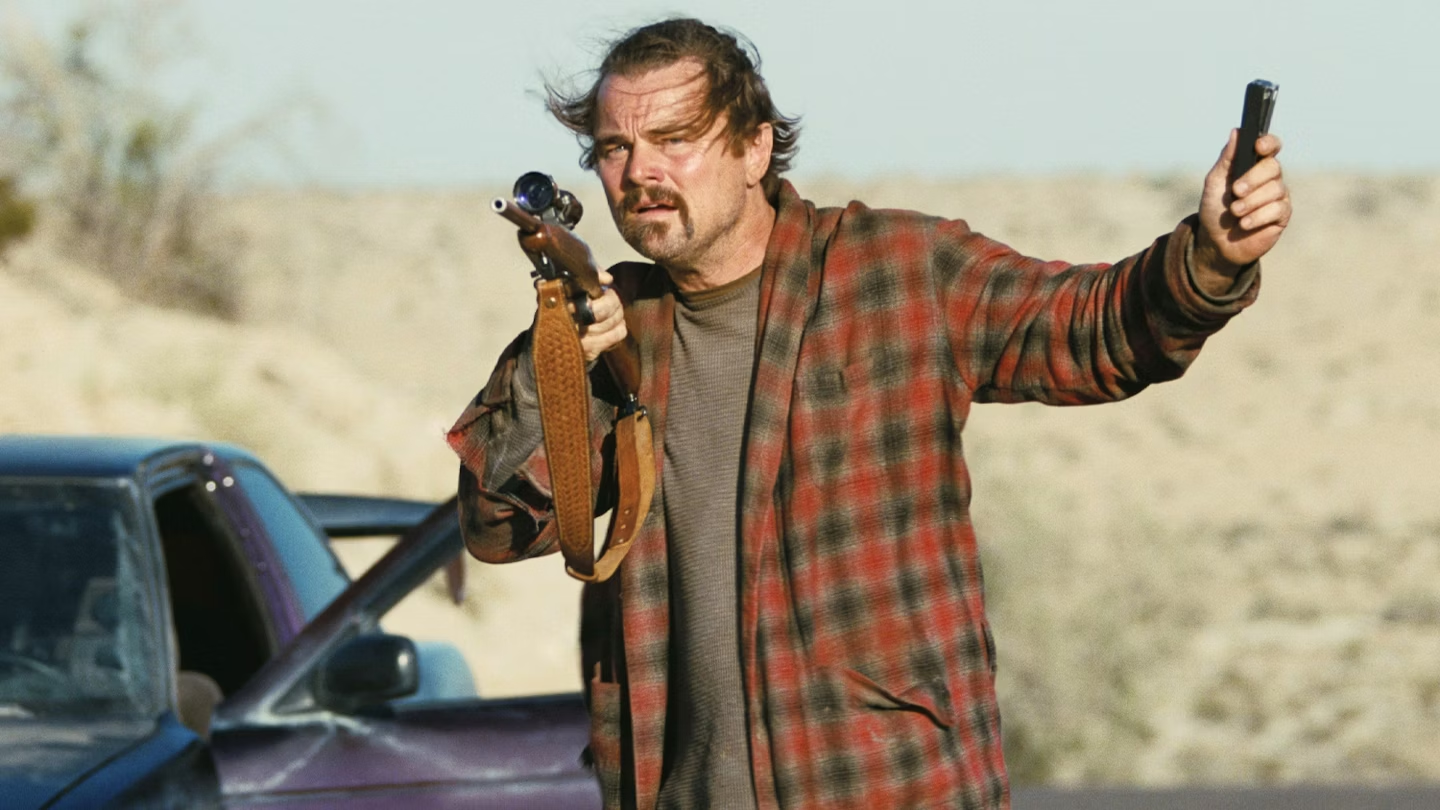
From it’s opening prologue which depict an extensive history behind the French 75, our far-left revolutionary heroes, One Battle After Another is gripping. Leonardo DiCaprio is spectacular, yes, having to carry much of the movie on his back and go from a genuine revolutionary to a weeded out, drunk single father just trying his best, but it’s in these early moments it becomes clear the movie isn’t really about him in the traditional sense. This movie really becomes the fuel for performers like Teyana Taylor and Regina Hall, who both command the screen with their presence. And then it’s also Chase Infiniti’s once the prologue finishes and we are in the meat of the picture, whose screen debut is nothing short of a revelation – an immediate movie star in the making. Her scenes alongside the creepy, menacing, and impossibly evil Sean Penn (who himself is giving something of a career best villain role here) are some of the flick’s best, and most of that is due to Infiniti’s wholly unique and arresting screen presence. And that’s not even diving scene stealers like Benicio del Toro or Tony Goldwyn, both of which are memorable for different reasons – Del Toro’s line delivery of “a few small beers” will live rent free in your head for weeks.
And once the film gets going, with Jonny Greenwood’s pulse pounding out of tune piano score and incredible sound design blaring through the speakers, Anderson is really free to let much of the screen do the talking. With gorgeous locales shot on beautiful 70mm, One Battle After Another might be one of the first truly modern films to look classical. Despite it’s modernity in every aspect – Anderson even avoids the age old adage of “cell phones ruin everything” by actively incorporating them into the story naturally – much of One Battle After Another feels old school in the best way possible. It has a grainy, textured look to it. It’s characters wouldn’t be out of place in a 70s or 80s thriller, which lines up with the film’s loose influence from Pynchon’s Vineland (which, despite the changes, is remarkably faithful to in key ways). It somehow feels timeless and omnipresent while also being remarkably current and made in the moment.
I have been thinking constantly about One Battle After Another since I’ve seen it a week ago. This review is exceptionally late because finding the words to really describe it has been difficult, to say the least, as my thoughts are ever evolving on it. As I sit with it, I find myself drawn to new elements of it’s construction, like how Bob Ferguson barely makes a dent in the main story but that’s ok cause the fact he’s even out here searching for his daughter is enough for her. Or how Sergio-sensei feels like the hero from another movie in the best way possible, with his own layers and layers of characterization just hidden away, waiting to be unlocked.
There is no doubt in my mind that One Battle After Another is one of the best films of the year. Where it ranks on Anderson’s filmography is hard to say at the moment, but it’s clear to me he’s made another masterclass in craftsmanship and has also managed to finally make a film that feels easy enough to recommend to literally everybody. Without question one of the year’s most relevant and timely movies, one of it’s most entertaining, and will likely be one of my personal picks come year end.
 Matt's Media Corner