By Matthew Moorcroft
Highest Recommendation
- Directed by Jafar Panahi
- Starring Vahid Mobasseri, Mariam Afshari, Ebrahim Azizi, Mohamad Ali Elyasmehr
- PG-13
There really isn’t another filmmaker quite like Jafar Panahi, whose essential work in Iranian cinema is, of itself, an act of supreme defiance and rage. But while he isn’t the only director in recent memory who has been doing this type of work – just take a look at Mohammad Rasoulof from last year with The Seed of the Sacred Fig – but Panahi is particularly unique in how his films consistently blur the line between documentary and narrative. Thus is the nature of guerilla filmmaking and how it’s a cycle that feeds into itself; the story shifts with how the world around you shifts, and you simply adapt.
Beginning with the image of a seemingly loving family on the road home, It Was Just An Accident lets it’s story unfold patiently after said family is forced to stop for repairs after accidentally hitting a dog. As the mother says, “it was just an accident”, but said accident leads to a chance encounter with Vahid, an auto mechanic who remembers him very, very well. As a political prisoner, he never saw his face, but he did hear his voice. The creak of his prosthetic leg. And the words of his cruelty. And Vahid can’t escape it, he knows this, but he can sure as hell do onto his enemies what they did to him.
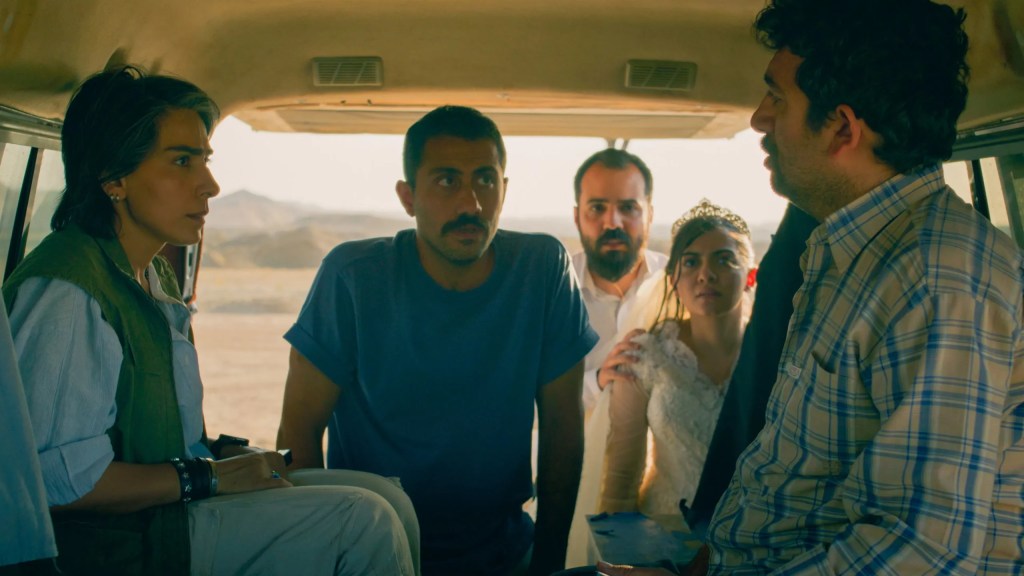
With it’s pulse directly on human nature and how we as people respond to moments of great trauma, It Was Just An Accident is achingly human in a way most pictures can only dream of being. It’s deft balance of tense character work and a ticking time bomb combined with it’s bursts of dark humor and emotional sincerity make it hard to pin down as a singular genre exercise, but it also means it runs the gambit of emotions and the human experience effortlessly. Once Vahid begins meeting the rest of the cast, almost entirely made up of people who have had their own experiences with the Iranian regime, you see the different ways those moments of trauma have affected them. Some, like the bride Goli or the volatile (and sometimes very funny) Hamid want him dead immediately, while others like the photographer Shiva are more worried about the aftermath.
That central question, revolving around whether or not it’s even just to resort to the same brutal methods of your oppressors and if that will bring proper justice, is at the heart of It Was Just An Accident, and Panahi gives no easy answers for the audience here. Instead, he just lets the story play out naturally and organically, less interested in shocking the audience or classical narrative structure in favor of being something of a fly on the wall for the majority of the picture. The organic nature of it’s storytelling, which extends to not just it’s naturally lit cinematography but also it’s delicate script that isn’t flashy or pompous, also means It Was Just An Accident forces itself to sit down with the cast often, letting moments sink in for both them and the viewers who have to contend with this being the reality of their lives.
And all of this leads to a bravura final sequence, done almost entirely in a single unbroken take, that takes the mask off and shows the depths of the anger that Panahi has towards what is happening in his country while also giving the audience maybe a small taste about what it was like for him, and many others, who had to endure the torture of prison. It’s a clear cut case of how killing somebody won’t only not solve their own inner demons, but also might actually be a blessing in disguise for their oppressors, whose own beliefs are so deeply entrenched in a society and government that has indoctrinated them to believe in their cause to the point of death.
It’s those final moments, as well as a haunting final shot, that lets It Was Just An Accident linger in the back of your skull like the same squeak of the prosthetic that the entire cast can never truly escape from. And yet, in spite of those haunting final segments, I think it ends up being the true beauty of It Was Just An Accident that it’s also deeply humanistic in it’s approach to others. The cast still takes the time to try to take wedding photos, make a connection with a pregnant mother (albeit one connected to the man they are trying to deal with), and argue and bicker less like enemies but more comrades simply trying their best in a bad situation.
It’s in those moments that It Was Just An Accident became one of my favourites of the whole year. It’s a masterclass of tonal control; totally content with just letting the story play out without much fanfare or big reveals. Instead, it wants you to find some humanity in the politics that it so clearly is playing in, but when your very existence as a film is inherently a political statement, it’s the only thing you can do. Film is an accident itself, after all, so why not record what we see?
 Matt's Media Corner