By Matthew Moorcroft
Strong Recommendation
- Directed by Hikari
- Starring Brendan Fraser, Takehiro Hira, Mari Yamamoto, Akira Emoto
- PG-13
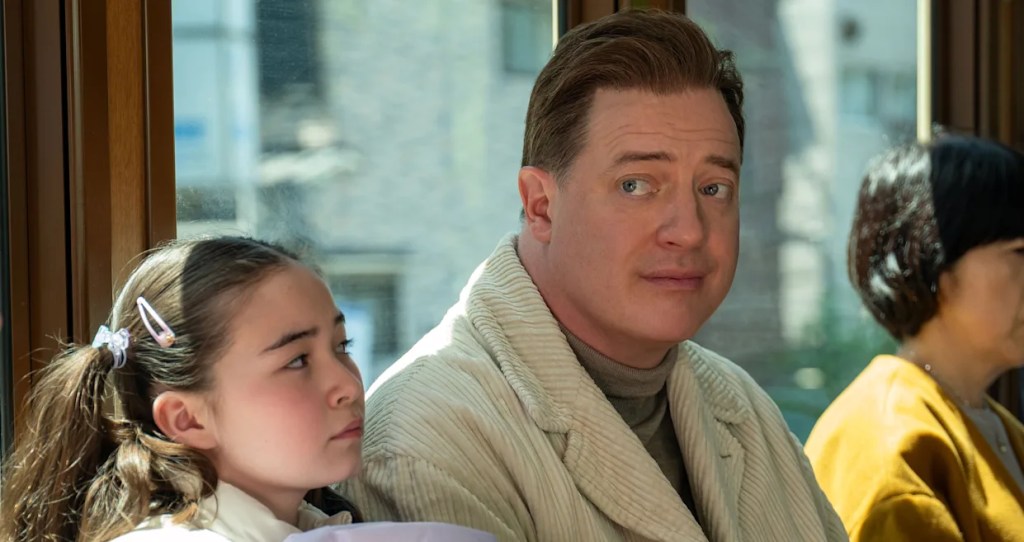
It’s not hard on the onset to see Rental Family, Hikari’s sophomore feature outing and her first major one in the Hollywood sphere after making a name for herself thanks to her work on Beef, as an easy star vehicle for Brendan Fraser post-Oscar win. Fraser’s own personal persona as of late fits the bill well of what the film is trying to accomplish, which is that of the kind of sweet that goes well with some happy tears and a little bit of laughter.
And while it most definitely is that once you actually get into it, Rental Family is thankfully a very, very good version of that and manages to sneak away with your heart fairly quickly and never let go. It’s a winning combo of a film; both subtly witty and observant about the world it inhabits while also grounding itself in likable but still realistic characters that wouldn’t feel out of place in the work of Hirokazu Kore-eda. It’s sweetness but never hits overly saccharine, more instead maintaining a certain level of restraint in itself that is admirable.
What ultimately begins as a strange gig for our lead character, Philip, slowly morphs into something which Shinji, played by the ever talented and increasingly commonplace Takehiro Hira, is convinced is a natural good. Japan as a society is still stigmatizing mental health and built on a foundation of internalization, and Shinji argues that his “rental family” business helps people release their inner emotions in a way that’s safe and in the boundaries of their own personal comfort. It’s a difficult premise to buy, and both Philip – and likewise the film and it’s director – know it, and while that interrogation is ultimately more minimal then anything, it’s clear that Hikari is more interested in the effects that a singular individual can have on a person’s life. Or, this case, what a single person can do for many if they just put their minds to it.
These people that Philip effects, which range from a young mixed child who is desperate for a father figure, an aging actor on his last legs, or a young lesbian woman who is trying to escape patriarchal norms, are given just enough depth to remain compelling. Akira Emoto as said aging actor is the easy standout of the supporting cast, with a likability combined with a fun grouchiness that harkens back to classical portrayals of grandparents in the films Hikari likely grew up on.
Hikari’s script, which she co-wrote with Stephen Blahut, manages to keep things moving quickly, balancing between these three storylines while maintaining a light air about it. It’s never gut bustlingly funny, but it’s certainly amusing at the best of times and has a couple of particularly strong gags scattered throughout to maintain that soft atmosphere. But while those dramedy vibes are appreciated, it’s really in the details that Hikari’s script truly excels and manages to find some thematic meat. As a daughter of two worlds herself, born and raised Japanese but having moved to the United States for college and lived there for a good chunk of her life since, Hikari uses Philip’s own status as an American living in Japan to highlight unique cultural differences and similarities. Fraser is fully up to the task for this, pulling off the difficult task of playing somebody who is clearly not of this culture but has lived there long enough to consider said culture their home. Mari Yamamoto’s Aiko, who has her own struggles as a rental actress who specializes in, well, infidelity cases, is able to bounce of Fraser nicely in this regard by being his way into Japanese society without ever coming off as a white savior even if Aiko herself is slightly underused with a storyline that feels like it could have been it’s own movie let alone more room to breathe.
And Japan itself is almost a character in of itself here, with the incredible cinematography by Takuro Ishizaka giving the lush landscapes and gorgeous locales of the country a heavy amount of focus. A detour in the second half of the film which sends Philip cross country is a particular highlight as the warm sun beats down on the film, radiating it in this warm glow as Hikari’s confident direction and striking tableaus keep every shot absolutely stunning to look at. It could have been so easy for this to look like a streaming project as many of these types of flicks tend to, but there is a surprising amount of precision here and it makes for a excellent viewing experience.
Those who cannot stand sentimentalism in their films might wanna look away from Rental Family, but as we get further into a world that itself is seeming more and more cynical by the day, Rental Family feels like the kind of picture you need every once and awhile. It’s vibes are very similar to the cherry blossoms you would see every spring time in Japan – light as a feather, gorgeous to look at, and fills you with a sense of renewal and joy that you aren’t going to get anywhere else. And frankly, as somebody who considers themselves a sentimentalist first and foremost, I found Rental Family both moving and charming, which is a big win in my book.
 Matt's Media Corner