By Matthew Moorcroft
Highest Recommendation
- Directed by Tatsuya Yoshihara
- Starring Kikunosuke Toya, Reina Ueda, Fairouz Ai, Tomori Kusunoki
- R
There is a moment early on in Reze Arc, the feature length sequel to one of the most popular anime of the past decade, where our lead Denji – fresh off his defeat of one of his toughest foes yet in Katana Man – goes to the movies with his mysterious boss Makima. Or rather, movie theater hopping, seeing a new movie each time. Makima’s reasoning is that she usually only finds one in every ten movies she sees to be actually worth it, and when her somewhat mediocre reactions to the marathon that they are having show up, it becomes clear she has a very specific taste. But it’s not until the final movie, which is the Russian classic Ballad of a Soldier to anybody with a knowledge of film history, that both Denji and Makima find themselves moved to tears. They aren’t sure why, but the short expression of love and affection for somebody that they barely know is enough to set off the waterworks. Little does Denji know, that very thing would happen to himself almost immediately afterwards as a girl named Reze (played by the immaculately cast Reina Ueda) finds herself getting closer and closer to him, putting his own romantic interests into question.
Reze Arc is a lot of things. It’s a high octane, ultra gory action flick that has more in common with the B-movies of Troma then most other shonen, taking sheer delight in the darkly comedic shenanigans that erupt from it’s premise. But like the best of Tatsuki Fujimoto’s work, initial premise is really only the surface level of Chainsaw Man, and Reze Arc finds that most obvious in how, despite it’s delirious color scheme and over-the-top atmosphere, so much of Reze Arc is clouded in small subtleties. Reze herself is surrounded by this, as it’s difficult to really get a grasp on her once the shoe actually drops about what her deal fully is in relation to Denji.
Those small moments define Reze Arc, which uses it’s tragic romance as a vessel for an emotional gut punch that is uncommon among anime action flicks. Lesser films would have simply used Reze as either a damsel in distress or a straight up villainous femme fetale, but Reze Arc does neither. Instead, Reze is a complicated, human figure who sees Denji as her way out, her target, and her genuine “one and only” in time. Her mask becomes what she is, the two so intertwined that it’s almost nigh impossible to tell them apart. One could feasibly argue this has become Denji as well, as his reluctance to move away from his situation with his job and just live a normal life has literally become part of his identity, a core belief. Both parties can’t see past their own masks.
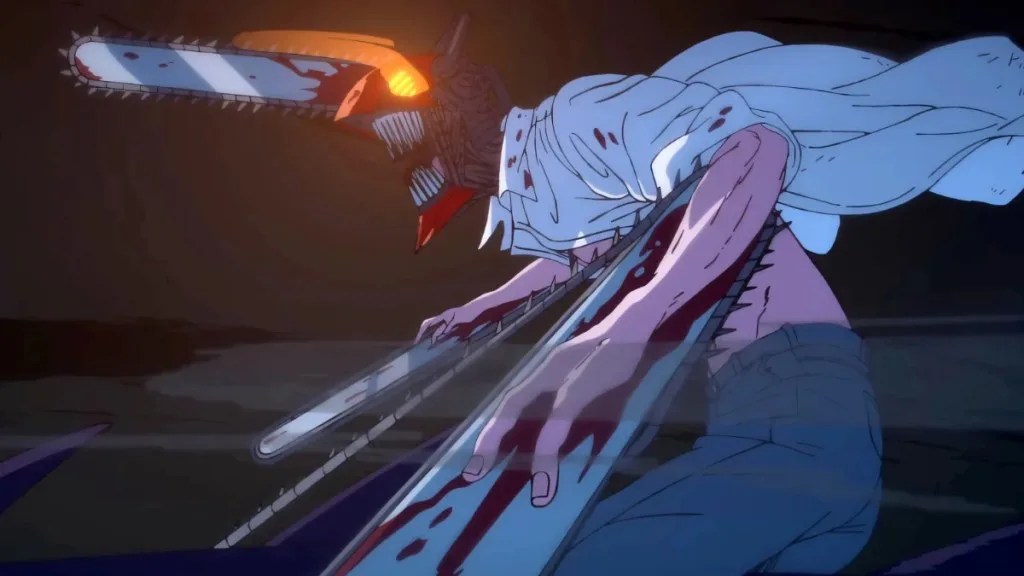
Taking over from Ryu Nakayama’s more muted, grounded approach to the material in the show, newcomer director Tatsuya Yoshihara’s approach is far bigger, bolder, and maximalist, but considering the material that might actually be for the best. While Nakayama’s take emphasized the ennui of capitalism in a way that I don’t think Yoshihara would have been able to capture, there is something to be said on just how well Yoshihara is able to board and portray Fujimoto’s rainbow colored carnage. There are moments here that almost feel like a painter threw whatever he had on the canvas, and yet it remains easy to decipher and understand in spite of the chaos. The animation work here is nothing short of spectacular, and it’s hard not to immediately lose yourself in it and miss key details on a single viewing.
And just like the rest of the show, it’s populated by an extensively fun supporting cast who all bring their own unique quirks and personalities to compliment the sincere nature of Denji. While some like Power or Kobeni, mainstays in the show, get very little to do here, the film instead uses this chance to give characterization to characters like Beam or Angel, who take this chance to become more fully fleshed out figures in their own right. Angel in particular, a demon whose angelic nature is purposefully at odds with his demonic instincts, gets a lot to chew on here with his complicated relationship with Aki, whose burgeoning friendship parallels Denji and Reze’s romance and feels somehow equally doomed.
But it’s in that doom that Reze Arc, and likewise the entirety of Chainsaw Man, finds a level of hope and light within the darkness of it’s material. Denji still believes in the good of Reze even after all that’s happened to him, simply cause he has seen beneath the mask ever so slightly. Reze Arc asks us as people to not only look past those masks, but to also savor the small moments we do get with people, even if it’s only for a brief spec of time. Reze enters and leaves Denji’s life just as quickly, but her impression will last for much longer and maybe even for the rest of his life. It’s what makes the final images of the film, one of a needless tragedy, so much more painful and emotionally gutting.
Just in terms of pure emotional cartharsis and beauty, I don’t think there will be another animated film this year quite like Reze Arc. It’s a sublime picture, moving beyond it’s status as a franchise moneymaker and becoming a truly masterful piece of craft from a technical and narrative perspective. And while it’s likely Chainsaw Man will continue onwards into another season and beyond, it’s very possible Reze Arc remains the pinnacle of this adaptation’s achievements.
 Matt's Media Corner