By Matthew Moorcroft
Solid Recommendation
- Directed by Kenichiro Akimoto
- Starring Ai Mikami, Natsuki Hanae, Kana Hanazawa, Mo Chugakusei
- R
The second film adaptation of the Japanese novel, All You Need is Kill is in a strange scenario that doesn’t happen often in the medium – specifically that of the American version being the first one out of the gate. Having previously been adapted as the great Tom Cruise vehicle Edge of Tomorrow, the original text of All You Need is Kill is a goldmine of opportunity for experimentation with it’s premise which boils down to Groundhog Day mixed with Starship Troopers. How many ways can you kill off your lead character? What kind of resets will you do? How will you deal with the isolation of being the only one, or seemingly the only one, in this unique kind of hell?
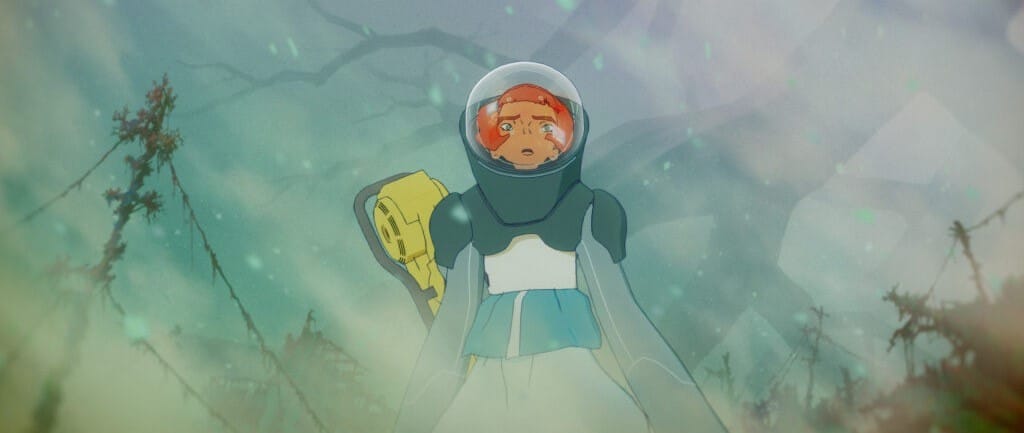
Those expecting this to be a more loyal adaptation then it’s live action counterpart though will likely be disappointed, as Studio 4°C switches around protagonists and focus to deliver a new telling of the story that’s far smaller in scope and more intimate in nature. This approach gives the first half of All You Need is Kill, with it’s melancholic atmosphere and oppressive sound design, a real feeling of beautiful, striking horror. The tree known as Darol is both a kaleidoscopic thing of beauty and a terrifying, creeping monstrosity that’s basically as alien as it gets. It’s origins are a mystery and remain a mystery throughout the majority of the runtime, and Rita, our lead, can only do her best to survive loop after loop of this pain.
Rita’s loneliness is obvious from the first scene of the film, but her being stuck in the loop only makes her situation worse and more desperate as she just wants a way out. She has the skills to survive at this point – shown through a really fun video game, roguelike sequence of her trying out different weapons and skills to get through what is basically a run – but whether or not she is helping people is not exactly part of the deal here. This all changes though when she meets Keiji, another looper who has been accidentally brought into this, and she is able to find a companion who might actually be able to let herself live for once.
It’s also this development that begins to somewhat sink All You Need is Kill, which has a tonal whiplash in it’s second half that fails the reconcile the darker undercurrents of it’s premise. It never becomes a bad film, just a completely different one that plays more like a sci-fi romance with action elements then the more high concept action horror that it started out as. Keiji himself is likable enough, and his chemistry with Rita is cute if surface level, but the dissonance from it’s first half never really escapes it as All You Need is Kill rushes towards a conclusion in it’s brief runtime of 82 minutes.
With a story this somewhat thin, it’s really thankful that All You Need is Kill is such a visual delight. 3DCG in anime have come a long way and this is by far and away one of the best examples in recent memory of how to do it right. The unique character designs, which eschew typical anime stylings in favor of body proportions that reflect character personalities – Rita is angular and sharp, Keiji is soft and round, etc – just pop off the screen in the CGI format, and the action sequences are fast, frenetic, bloody, and wildly inventive with a final setpiece in particular standing out as a marvelous achievement; blacks and reds clash against the swirl of spirals and neon that explode in one final crash of blood.
Stylization is the key to understanding the overall success of All You Need is Kill, which is a film that is better then the individual sum of it’s parts. Like the loops themselves, you just need to lose yourself in the vibe of the whole affair and go along for the ride, even if that ride ends in a way that leaves a little bit to be desired after an emotional moment of cartharsis is slightly undercut. It’s a feast for the eyes and ears, and on the big screen it transforms at moments into a beautiful symphony of high octane action and trippy storyboarding. First time director Kenichiro Akimoto, who had been a CG animator at Studio 4°C for some time prior to landing this gig, shows himself to have a keen eye for visual composition in his fight scenes, and the strong editing and smash cuts keep our deaths feeling sudden even if they are inevitable.
When it comes to adaptations of the original material, Edge of Tomorrow probably still has the edge as the definitive version at the moment, but this one makes a good case for itself as a standalone work. If anything, it makes a good companion piece, a more thoughtful and introspective version of the story that has a lot on it’s mind visually, if not narratively. A solid effort across the board, and a fun time at the movies for anybody in the mood for some high concept science fiction.
 Matt's Media Corner