By Matthew Moorcroft
Highest Recommendation
- Directed by Chloe Zhao
- Starring Jessie Buckley, Paul Mescal, Emily Watson, Joe Alwyn
- PG-13
In some ways a return to form for acclaimed indie filmmaker Chloe Zhao in terms of subject matter, Hamnet is positioned on the surface as a much deserved victory lap film after her Best Picture winning Nomadland swept audiences away and her divisive MCU flick Eternals confused those same audiences (even if it as maintained a strong cult following). It’s a lavish period drama with some of the most beloved newer actors on the scene, as well as based on a popular pandemic-era novel that exploded thanks to it’s timely themes of grief and loss. It’s the type of premium Oscar bait that we don’t actually get much of anymore, especially as the Academy has become increasingly unconventional with the types of movies they award, and Zhao’s own directorial style lends to a raw authenticity that wouldn’t be found elsewhere.
But when it ain’t broke, don’t fix it. To say Hamnet is devastating is an understatement; it’s a pure sensory overload of emotional pain and sorrow, held together tightly by Zhao’s patient, quiet direction and two painfully real, tremendous performances at it’s center. Some will call it calculated and manipulative, others will call it focused and sturdy. I happen to be the latter on that front, as Hamnet‘s script is laser tight and engrossing, managing to be period accurate in it’s dialogue without it distracting from the very tangible feelings on the surface here.
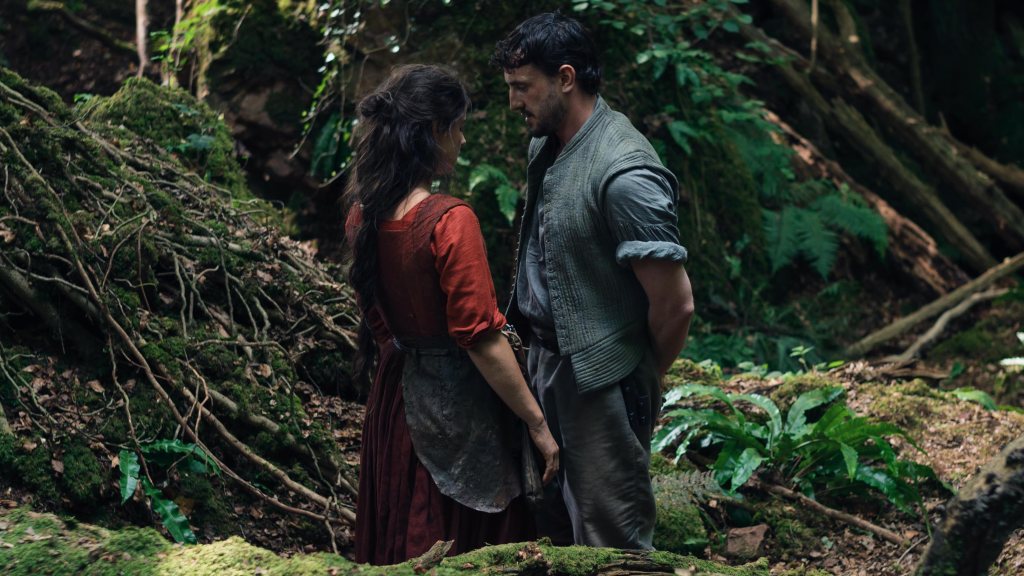
What’s ultimately the clincher here and what makes Hamnet highly effective is it’s more spiritual approach to the material. Agnes, Shakespeare’s long speculated about wife, here is re-characterized as the daughter of a “forest witch” who don’t doesn’t follow Christianity and has a more naturalistic view of the world. She sometimes sleeps in the forest, has a pet hawk, and knows herbal medicine that would otherwise not be known to the god fearing men and women of England. When she eventually marries the kind, if enigmatic and aloof, William Shakespeare, she even returns to the forest to give birth on her own. It’s this spiritualism that characterizes the entire film even down to Zhao’s direction, which feels less like a telling of historical events as it does a fable in it’s own right.
That naturalism in her direction, combined with a slow, sometimes unmoving camera, and lighting that goes out of it’s way to be as candlelit as possible – darkness here is used effectively as a way to show a creeping dread as the tragedy comes closer – means the quiet nature of the trauma is the main focus here. Hamnet himself, played by a revelatory Jacobi Jupe, is given ample amounts of restraint in his presentation. He isn’t just a cute child ready for the slaughter, he feels like an actual kid with his own personality, and it makes his difficult to watch final moments all the more tough.
Tough is a right word to describe Hamnet as a film even beyond the obvious subject matter surrounding it’s title character. The entire film deals with tough, sometimes alienating subject matter, but Buckley and Mescal are up to the challenge here and they center the flick in a way that I don’t know if it would have actually worked otherwise. Buckley in particular, bouncing back and forth between a lively, assured, and opinionated woman, a caring wife, and a mourning mother, carries so much of the film on her back. It’s easily the performance of her career up to this point, and her final moments with Hamnet is some of the most devastating pieces of acting you will see this entire year.
And when the film’s connection to Hamlet reveals itself, the film really clicks into place as we are allowed to process the grief right alongside Agnes and William. A shot of the entire audience reaching towards Hamlet in a shared moment of understanding seals the deal, everyone deep down understanding Agnes’ deep pain without needing to say a word. The last 10 minutes of Hamnet, which use Max Ritcher’s most famous piece as it’s clincher, is difficult to not find some emotion in. The rest is silence, after all.
Call me an emotional sucker, but Hamnet floored me throughout and left me a wreck. Like Agnes, I’m not exactly the most religious person in the world – if not at all – but I’ve always found some level of appreciate for that connection between living things. Grass, animals, trees, humanity, dirt. And with Hamnet, that vibe is everywhere. It’s gorgeous cinematography and production work help in giving the feeling of floating through air, viewing the events as a casual observer rather then an active participant; these painful memories left before us and nothing we can do to alter fates and destiny. And it’s in that spiritual connection that Hamnet fully engrosses you and doesn’t let go. It’s not a wonder why it’s a favourite come awards season, and it’s certainly one of mine. Another winner from Zhao.
 Matt's Media Corner