By Matthew Moorcroft
Weak Recommendation
- Directed by Ian Tuason
- Starring Nina Kiri, Adam DiMarco, Michele Duquet, Keana Lyn Bastidas
- R
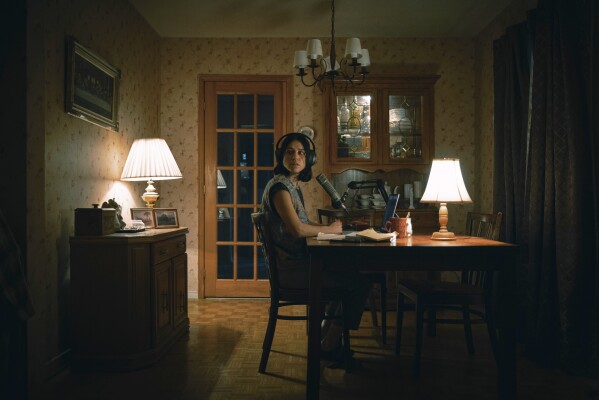
One of the canon rules of horror is that usually what you don’t see is scarier then what you do see. Undertone, with it’s focus on auditory horror and a sole lead actor on screen for the entire runtime, feels like the ultimate test of that canon rule. With almost everything coming from the closeness of headphones and the crusty MP3 files of amateur audio, it’s impossible to not feel at least a little uncomfortable watching, or listening, to Undertone, which uses it’s audio design to tell a story of a podcast gone horribly wrong.
It’s an admirable conceit for sure, and in an age where horror is seemingly evolving with it’s audience it makes sense that it would go this direction. The rise of creepypastas and analog horror like Marble Hornets and The Backrooms have completely altered a generations taste in what scares them, and something like Undertone – which actively uses the idea of hidden messaging in music and reversing audio in it’s conceit – fits the bill nicely. It replicates the feeling nicely of finding a piece of audio on Youtube that sounds a little “off” or a downloaded WAV file that’s corrupted at the end.
And when Undertone reaches it’s climax, which pays off the constant usage of negative space in the cinematography and the spooky audio layering, it becomes a nigh perfect version of itself; an deeply spooky, evil infested flick that starts opening up the gates of hell by the end of it’s final seconds. Things are happening in the background but you can’t focus on it cause the horror is in your ears, and the noises from the real world blend in and you can’t tell what is real anymore.
It’s good that Undertone does end so strongly cause the lead up is, unfournately, a little too bog standard for it’s own good, likely too afraid to fully embrace it’s podcast conceit in fear of alienating the general audience. Compared something like Skinamarink or We’re All Going to the World’s Fair, both of which had a remarkable confidence about the way they presented themselves and their ideas of analog nightmares, Undertone feels scaled back and blunt in it’s execution. It takes one too many breaks in the action, a couple too many soft resets, and while Nina Kiri is certainly trying and her performance indicates a deeper character underneath it’s clear that the film is struggling to find a thematic center.
That muddied nature of the film’s script is especially evident in the film’s somewhat shaky backbone of it’s premise, which threatens to slowly fall apart at the seams once you give it too much thought. Evy and Justin themselves have a vague history that doesn’t have much in the way of depth, and their actual podcast recording is shown in a way that anybody with a cursory knowledge of the medium will find to be inaccurate at best and downright preposterous at worst. The relationship between Evy and her mom, clearly fractured from a lifetime of obvious Catholic guilt, is probably the closest the film has to something grounding it but like the rest of the film it’s left too vague to really delve more into outside of the obvious shots of the virgin Mary. Moms and children seem to be a constant source of horror in Undertone, which almost views the act of a mom killing their child as the most horrific thing somebody can do – which, when your protagonist is also pregnant, has implications about abortion and the pro-life/pro-choice debate that feel icky on the surface and deeply misguided the further you look into it.
Despite all of that though, I still left Undertone unnerved, particularly once the theater was in the rear view mirror and all I could hear were the sounds of the rest of the world. You never exactly know what’s behind you at any time and there is a level of paranoia that Undertone does immediately tap into and it’s certainly effective. I can’t say Undertone is particularly intelligent when it comes anything beyond it as a stylistic exercise, but as said stylistic exercise, it’s got all of the right ingredients and makes it count in the correct ways.
 Matt's Media Corner