By Matthew Moorcroft
Strong Recommendation
- Directed by Damian McCarthy
- Starring Adam Scott, Peter Coonan, David Wilmot, Florence Ordesh
- R
As early as five minutes in, Hokum is already going for the jugular. To some, jump scares are an easy tactic, but to somebody like Damian McCarthy it’s clear that it can also be an artform in itself; a sudden release of tension and fright that comes at just the right moment to put the fear of god back into somebody. And almost as soon as the first background fright in Hokum makes itself known, it becomes clear that McCarthy is already a master of the perfected scare.
As calculated as a haunted house ride and as spooky as the best creaky mansion, Hokum is a fine tuned machine of gothic, spectral goodness. It’s an all meat, no bullshit affair that gives you what you paid for and then some, giving you both a gorgeously crafted good time at the movies while also a dark, haunting heater of a flick that has imagery that sticks around in your subconscious long after you watch it.
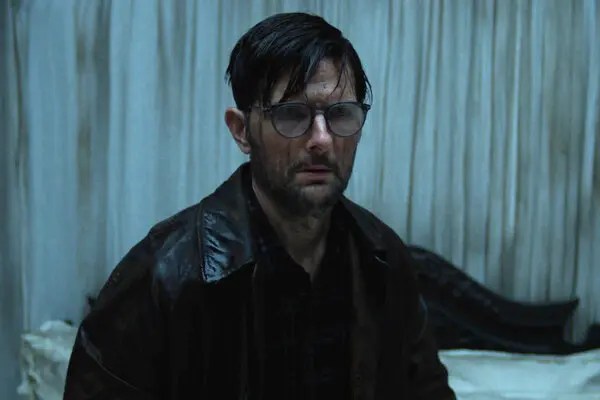
Which is the true hallmark of a good writer, something that Ohm Bauman – played by the effortlessly amazing Adam Scott in a rare leading man role that’s a true showcase of his talents – should probably know. But he has something of a block at the moment, unable to find a proper ending to his long running story. He himself is convinced that it requires something of a somber ending, but Ohm himself is a somber, bitter man with unresolved trauma in regards to his own past and that reflects in his art. After all, art does reflect the subconscious of the people who make it even if they themselves do not realize it.
That subconscious makes itself known in Hokum as we enter deeper into it’s maze of secrets, or in this case a locked off haunted suite which hides a deadly secret that Ohm has found himself in the middle of. After a good bout of setup, the majority of Hokum is locked in a singular room for much of it’s runtime, setting up it’s intricate geography and numerous Chekov’s guns like literaly clockwork. It can seem like busywork, but McCarthy clearly knows the value of a proper slow cooker and there is something to be said about how well paced and framed much of Hokum actually is. Every shadow feels like it’s staring back at you, every tense scare perfect telegraphed but still rewarding in it’s fright factor. It’s both an incredible piece of stellar production design while also a mark of excellent, moody cinematography that just has texture in every bit of it’s frame.
In fact, Hokum is so good at simply being a spooky time that you forget there is an actual story there to tell. That story does tend to get stuck in some overcomplication in it’s second half with a murder subplot that mostly exists to get our protagonist to the necessary spooky location, but it’s that relative simplicity that keeps Hokum focused and straightforward in it’s intentions. It doesn’t have a secret weapon up it’s sleeve nor does it need to have one; instead it uses the standard old tricks to great effect, especially in regards to it’s ghosts and supernatural imagery, which include a disturbing “human donkey” who makes up two of the film’s strongest scares. If anything, by the second half the murder itself becomes almost inconsequential to the story itself outside of simply giving an outside force a level of menace needed to start a ticking clock towards inferno.
That supernatural imagery, instead of the human element, is given room to breathe and simply be, as Hokum is more interested in the story around the imagery then the imagery itself. No explanation needed here, just the knowledge that something is up in the hotel and that there are hauntings afoot. It’s a clear sign of confidence from a filmmaker who has this down to a tee, and his restrained usage of blood also gives the sense that are there is something worse then straight up gruesome imagery around the corner. After all, Ohm descends into hell and then back again by the film’s end, only coming out after facing his literalized demons.
And that itself, with it’s refreshing unpretentiousness about being as open as possible about it’s intentions and approach, makes Hokum the kind of film that is great fun despite it’s seeming darkness. It’s those stream of scares that make us want to go to a haunted house in the first place, the idea of getting confronted with something we don’t really understand but overcome anyways in spite of our fear. Hokum taps into those very primal things, and it gets it. It’s not complicated, it’s not difficult, it’s not even that challenging like Ohm seemingly wants his art to be. It’s simple, concise, and rather effective.

