By Matthew Moorcroft
Highest Recommendation
- Directed by Kane Parsons
- Starring Chiwetel Ejiofor, Renate Reinsve, Mark Duplass, Finn Bennett
- R
In a year where horror has proven to be dominated the young, the youngest may have saved the best for last with Backrooms. At only 19 years old, Kane Parsons is a newcomer who has been given the once in a lifetime opportunity to adapt his own work to the big screen for a mainstream audience. And while Backrooms isn’t exactly lesser known by any means, as it’s large Gen Z following and internet origins will show clearly, it’s also a far more obtuse, strange property then what usually gets adapted to this large of an audience.
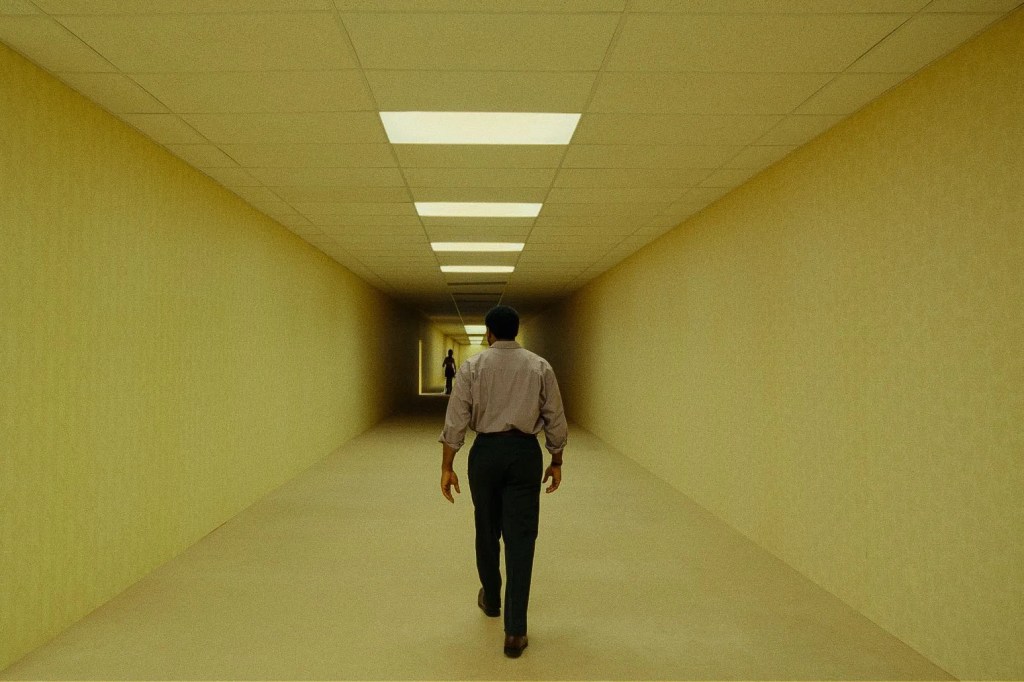
But times are a-changing, and horror is the first genre to truly meet the calling. While not the first of it’s kind, Backrooms is surely going to spearhead the charge forward with it’s bold filmmaking choices and deeply unnerving – and always tense – imagery that provokes primal fears of the uncanny. Everything is just like our world, but it’s… off, slightly. A chair with an extra leg or two. Lights that glow a little bit brighter then they should. Something that looks inhuman but moves like one, in the distance, clearly coming for you. It’s easy to read Backrooms as a sign of the coming misinformation age with the rise of AI, even if Backrooms as a film has it’s interests elsewhere.
It’s easy to give compliments to Parsons for even pulling this off, but what makes Backrooms so great is that you never really feel the pull of a first time feature director here outside of it’s script, which is blunt and to the point. But I’d argue here it works in the film’s favor as an extension of it’s visual nature; all dialogue mostly exists to service a brief understanding of the base concepts. The real meat is in how it’s presented, and Backrooms is a consistent triumph of visual storytelling and creepy atmosphere.
Much of this is thanks to the incredible work on the titular Backrooms themselves, a sprawling set that feels endless and maze like it’s construction. One room could lead to another entire section that feels like a completely different place, and the next could feel like an escape only to reach a strange dead end without much in the way of anything. It’s a testament to the production design team here but also Parsons’ clear vision for what the Backrooms themselves actually are, clearly seeing them as a representation of being stuck in the past both figuratively and literally.
But that production design is everywhere else as well, with it’s immaculately crafted period setting feeling both lived in but also, just like the Backrooms themselves, feeling off and just slightly wrong. Parsons’ mostly static camerawork and attention to detail allows it’s frames to pop off the screen and fill with you with this constant sense of dread. When you are walking down the rooms together with the cast in real time, you never know what’s around the corner. And those things in the corner of your eye could be real, could be fake. What’s to know for sure?
So much of Backrooms‘ ideas also lies at the feet of it’s two leads, who are both committed here. Ejiofor in particular, who plays Clark always at the verge of a breakdown but not quite there yet, feels like the perfect lead for this for much of it. The escape he’s been craving but also the rooms itself that he can’t forget, can’t move on from. Reinsve herself is also dealing with similar traumas, and as it goes on those memories become more and more surrealish and nightmarish to the point they bleed into one another like a simulacrum of existence.
That’s the real horror, and ultimately the true subdued success, of Backrooms as a film. It’s a stunningly bold, confident debut from a young talent with something to prove, and it’s imperfections are less black marks and instead clear signs of notable ambition. For every small line of clunky dialogue, there are multiple that sing. For every theme stated a little bluntly, it also has substance beyond there in how it’s presented and what it wants the audience to take away – or how willing it is to let the audience interpret what they wish. And in a year where horror is now defined by the young, a film that is ultimately about our inability to tell what’s real, what’s fake, and how much of that is just trauma manifested feels ever so relevant and resonant. One of the best of the year, small warts and all, and one that will likely get better as it ages with time.

