By Matthew Moorcroft
CONTENT WARNING: This editorial discusses themes of suicide and trans dysphoria.
In the 1983 body horror classic Videodrome, our lead character Max Renn, the CEO of TV station, continually finds himself being transformed and morphed into a being that is not himself. Starting with the psychological, with him slowly but surely having his mind turned by the TV station that he has become addicted to, all the way to his actual body with a gun fused to his hand. The film repeatedly posits that this new body is the “new flesh” and while in the context of Videodrome it’s mainly about that film’s focus on the very primal nature of humanity’s urges, it’s a clear cut representation of the body horror genre as a whole. The new flesh is in. The old flesh is out. Time to transform one’s self.
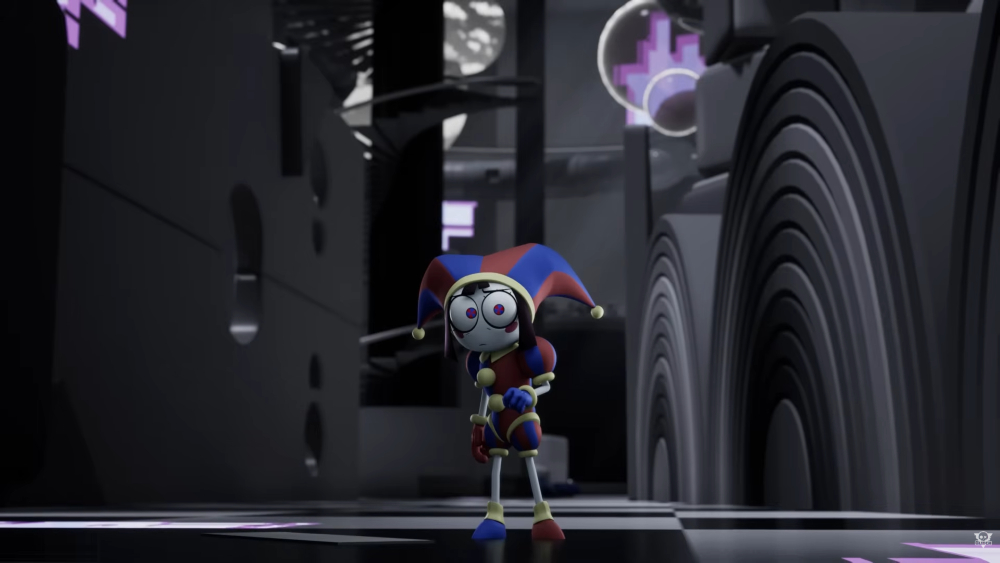
While it’s not technically body horror in the traditional sense, The Amazing Digital Circus, whose entire premise is centered around characters trapped in a virtual world with bodies that aren’t wholly theirs and where they cannot escape, is, in a lot of ways, a body horror story. It’s first scene sets it up very clearly with Pomni, our lead, trying desperately to tear off her own skin before realizing she’s trapped in this otherwise seemingly endless hell.
And while it takes it’s inspirations more from Ellison’s classic short story I Have No Mouth, and I Must Scream, that body horror permeates the rest of the narrative like a ghost. It’s impossible to avoid even as the show pivots effortlessly from dramatic character beats to surrealistic internet humor within seconds apart of each other. There’s always somebody who doesn’t feel like they are right, like that something about them is off. This is seen as early as the second episode of the show with the character of Gummigoo, whose status as an NPC in the world that Caine creates is something that makes him feel he’s not actually living, that he’s just a husk.
It’s that existential horror that gives The Amazing Digital Circus it’s bite, and for nine straight episodes released over nearly three years it was continuously one of the most unique web series on the market. I tend to avoid animated web shows nowadays – halfway due to being not nearly as online as I used to be so much of the humor doesn’t always land for me, and halfway due to being burned on RWBY one too many times (rest in peace Monty Oum). But even I knew something was special about The Amazing Digital Circus as soon as it’s first episode aired, with it’s colorful cast of characters, sharp writing, and deceptively simple narrative; this is the kind of creator driven story that indie animation has desperately needed and it felt like a hydrogen bomb in the midst of a sea of coughing babies. It was a magic trick that continuously brought out more magic tricks.
The Amazing Digital Circus‘ finale is it’s final, and most ambitious, magic trick yet, and that magic trick is simply that it simply doubles down on the show’s most interesting major conceit to effectively heartbreaking results – that of the horror of being trapped in a body that isn’t yours. And the key to that story is the show’s antagonistic Jax, whose self-destructive, selfish, and abusive tendencies finally come to bite her back as she abstracts. Beyond it simply being a gorgeously haunting visual, it sets up what The Amazing Digital Circus is actually about and why Gooseworx sought to tell this story in particular.
The Amazing Digital Circus is about the trans experience. This isn’t subtext, this isn’t a subjective claim, this is text. And while Jax’s story is the most obvious of this, I would argue it’s present in every aspect of the show, even down to how the show uses it’s concepts. While revelation that the cast are just brain scanned versions of real people is both a great twist on these kinds of stories and makes sense in the actual logistics of it’s world, there is a very, tangible fear that it recreates. That idea being one that you are stuck in a body you hate and you can never get out of it simply because you were born this way and there is nothing you can do about it other then to simply make the best of the situation without falling into some kind of darkness. That idea being you can’t ever be who you want to be because no matter what the system is going to view you a specific way and there is nothing you can do to change that. That idea being you are stuck in this fucking hell.
It’s enough to make you want to just end it all, right there and then.
There is enough The Amazing Digital Circus‘ finale that reminds me of Jane Schoenbrun’s spectacular I Saw the TV Glow, whose whole horror is built around the idea of a repressed trans person never transitioning and how that is of, in itself, horrific. The disconnect from everything else that can be felt when you feel like nobody else either understands you or how everything in the world just feels wrong. It’s a difficult feeling to properly express through words, which is likely why I Saw the TV Glow uses visual representations to great effect throughout it’s runtime.
While The Amazing Digital Circus is not a 1-for-1 with that film (though it would make for an excellent double feature), it deals with the same kind of subject matter in it’s subjects. It’s really not just Jax either; the fourth episode, the otherwise seemingly disconnected side story “Fast Food Masquerade”, directly deals with this as well with Gangle. Gangle is a character whose emotions are always hidden behind a literal and figurative mask, and that repression is ultimately what leads to her breaking point. She doesn’t feel like she belongs, like she’s real.
It’s also why characters like Zooble, who is the only member of the cast who mainly stays the same throughout the show’s runtime, are so needed. Zooble is the foil to somebody like Jax; while Jax has been running from the truth her entire life, Zooble has accepted it and has found a level of peace. They know who they are and that has given them a new perspective on life that the others lack. They are a grounding force, somebody that has already been through the arc that the characters are going through so to prove that there is indeed a light at the end of the tunnel.
And yet, in spite of the terrifying existential dread that makes up the bulk of the show’s effectiveness, it’s got the same message as I Saw the TV Glow and why I so truly believe these belong together in the same sentence; that there is still time. Not just time for acceptance, but time for forgiveness, for realization, for freedom. While it may not come for some – Jax is still abstracted by the end of the show and will likely stay that way forever, a husk of a person whose own repression of her true identity has killed her – it can come for others. Pomni learns to accept where she is, who she is, and makes the best of it even if it isn’t ideal. And she learns to forgive, and while we can argue day in and day out whether or not Jax deserves forgiveness, that’s not really important in my mind. What’s important is that empathy for the suffering is what will save us. And it’s what will save lives, in the case of those who cannot escape the hellscape in their minds.
I found The Amazing Digital Circus to be an ultimately moving experience. Even as a cis person who can never truly understand what it’s like to be trapped in a body that you don’t wanna be in, The Amazing Digital Circus‘ empathetic approach to the material – and darkly funny ways to make it entertaining in spite of it’s dread – is something that never, ever waivered. And in it’s last moments, with the real versions of the characters going off into their lives without any idea of their digital selves’ experiences, I am once again reminded of Videodrome. While that film’s ending is far bleaker, Videodrome has it’s moment early on when you start to see that separation of the digital with the real. There is the implication of Max, for the rest of the film, simply being a copy of the one who witnessed what has happened in Videodrome itself. If that is true, then we will never actually experience that feeling of the new flesh.
The real selves of the circus will never experience that “new flesh” either. But they absolutely still can. There is still time.
The Digital Circus is calling.
 Matt's Media Corner