By Matthew Moorcroft
Highest Recommendation
- Directed by Christopher Nolan
- Starring Matt Damon, Tom Holland, Anne Hathaway, Robert Pattinson
- R
At what point do we earn forgiveness for the sins we have wraught?
This is arguably the question that has permeated the entirety of Christopher Nolan’s career, who has spent two decades examining and reexamining the ways that flawed men try to atone what they perceive to be their greatest and most potent mistakes. From the various morally ambiguous actions of his take on the Caped Crusader to Cobb’s manipulation of his wife’s memory in Inception to even Cooper’s act of seemingly abandoning his children in Interstellar, it’s hard to ignore that Nolan himself might be reckoning with the slow march of what he believes to be humanity’s slow descent in self-destruction as well as his own demons. If art is meant to be reflective of the person making it, then very few directors are as personal as Nolan in that regard.
Coming off of the heels of his spectacular magnum opus Oppenheimer, The Odyssey feels Nolan reexamining himself in that regard. And it makes sense, as it wouldn’t a Nolan version of The Odyssey, one of the Western world’s most important texts and one of the foundations for many literary tropes we know take for granted, if it wasn’t self-reflexive and recontextualizing it’s own material as it goes on. This is an Odyssey where much of the story is told in narration much like the original poem was when it was first being spoken, one where it’s scenes are subjective to the point of questioning what exactly is real and what isn’t at least until it’s staggering climax.
And yet, it’s also impressive just how straightforward of an adaptation The Odyssey does still remain in spite of all of that. The real magic trick that The Odyssey pulls is not in what it changes, which is very little, but instead of how it actually tells the story. This turns The Odyssey into a story that treats the Trojan Horse much like the atomic bomb, and also into one about a man reckoning with the idea that he himself has broken the laws of the gods forever and that mankind has become doomed in it’s wake.
Much has been said about Nolan’s usage of scope in prior films but, due to the nature of the story being told here, The Odyssey easily dwarfs every other flick he has made up to this point. Every shot is gigantic and filled with detail, from the sands of the beach of Troy to the slowly crumbling ruins of Ithaca, and the battle sequences are large and impressively staged. It’s really in the results that The Odyssey looks as good as it does, with Nolan’s penchant for practicality and realism over grand fantasy that makes it such an interesting juxtaposition. Instead of running from the fantasy like many assumed that he would have, Nolan instead takes it as a challenge and fully embraces the weirder elements of Homer’s work. Much of the fun things about his version of this story is instead how he translates it and it’s all done with a clear giddy glee behind the scenes. There is a segment where the trees literally look like they are moving and it’s utterly transfixing.
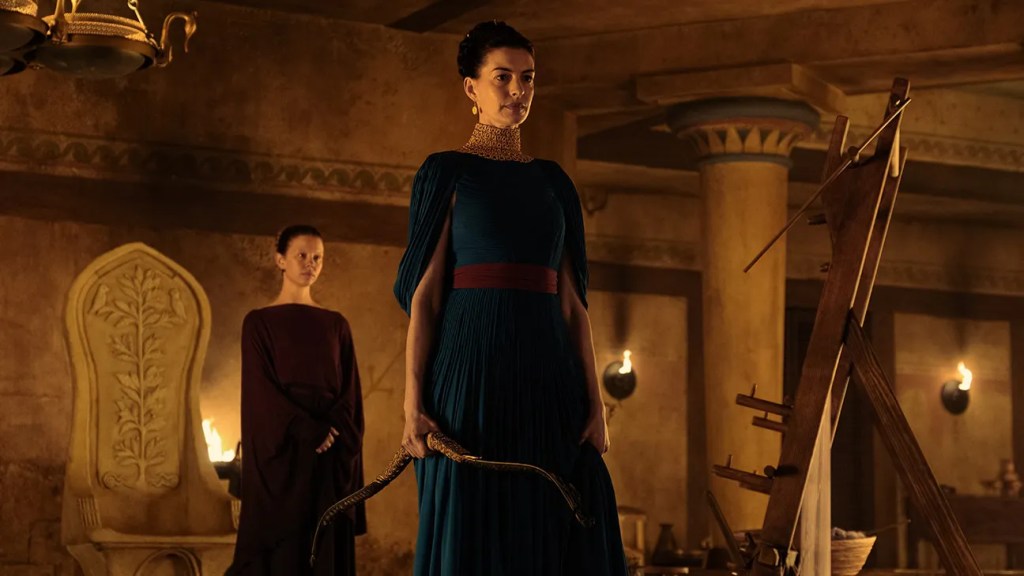
Every performance is on the top of their game here, though with the ensemble being in such high form it’s difficult to pick a standout. Matt Damon himself is a phenomenal Odysseus, translating the mythic hero into a more grounded, down to Earth general who just wants to return back to his wife at all costs, while said wife, Penelope, is given meaty weight by Anne Hathaway’s calculated turn as a woman far smarter then she lets on. Their son, Telemachus, is given a little bit of a thankless role due to being stuck listening for much of the picture, but Tom Holland is a hell of a facial actor and by the third act transforms himself into one of the film’s most formidable roles. John Leguizamo, Zendaya, Robert Pattinson, Elliot Page, and Himesh Patel are other standouts in the large, deeply impressvie cast, but it might be Samantha Morton’s one scene wonder as the witch Circe that might be the most impressive. Morton’s ability to play fake naivete with an impressive level of anger has to be seen to be believed, and her monologue about the nature of mankind ranks as one of the film’s most powerful moments.
There is so much to The Odyssey that sometimes it does feel like the film is overflowing at the seams, wanting to burst forth and completely lose it’s way as it keeps on trucking. But the final result is such a wildly satisfying series of payoffs, action beats, and genuine fist-pumping “hell yeah” moments – this might be Nolan’s most obvious crowd pleaser since The Dark Knight Rises, if we are being honest – that it leaves on the highest of highs and gives the rest of the movie a weight that justifies the whole thing.
It happens nearly every time he makes a movie, but The Odyssey does feel like Nolan outdoing himself again and then some. It’s mythic but also intrinsically personal, grand in scope but purposefully focused in it’s ideas, and wildly ambitious in both the big (it’s many, many boat sequences) and the small (Ludwig Goransson’s surprisingly restrained, non-orchestral score). It’s everything you wanted it to be and more, and one of Nolan’s finest.


One response to “Film Review: The Odyssey”
[…] director is as cyclical and as repeating as Christopher Nolan. As I mentioned in my prior review of The Odyssey, Nolan has been exploring similar ideas and throughlines in his career to the point where somebody […]
LikeLike