By Matthew Moorcroft
Highest Recommendation
- Directed by Jane Schoenbrun
- Starring Hannah Einbinder, Gillian Anderson, Jack Haven, Arthur Conti
- R
One of the most famous scenes in horror movie history is also, maybe, it’s trashiest. The opening scene of Friday of 13th, which follows two camp counselors sneaking off for a fun time away from prying eyes only to meet their violent ends at the hands of an unknown assailant, is voyeurism at it’s most extreme; equally as violating as it is titillating. It’s a scene that, for better or worse, is an imprinting moment for many viewers who likely viewed the film far too young and realized very quickly what certain things were.
This is exactly what happens to Kris Williams, a young queer filmmaker who is tasked with rebooting the suspiciously similar Camp Miasma franchise, whose popularity has faded with time and has been the subject of scrutiny for it’s blatantly transphobic subject matter in a similar vein to equally important slasher flick Sleepaway Camp. But while Williams has her reservations about being hired in the first place, her love for the series is genuine, and it all starts with that voyeuristic scene of Little Death causing, well, a little death.
Blending in and out of the film world to the point where it becomes difficult to tell what is and isn’t just make belief, there is a lot to digest with Schoenbrun’s Teenage Sex and Death at Camp Miasma, though anybody familar with their work should know that by now. Schoenbrun is not a subtle filmmaker by any means, but where their depth comes from is less in the details and more in the presentation, which is always metatextual and playing with form in new, exciting ways.
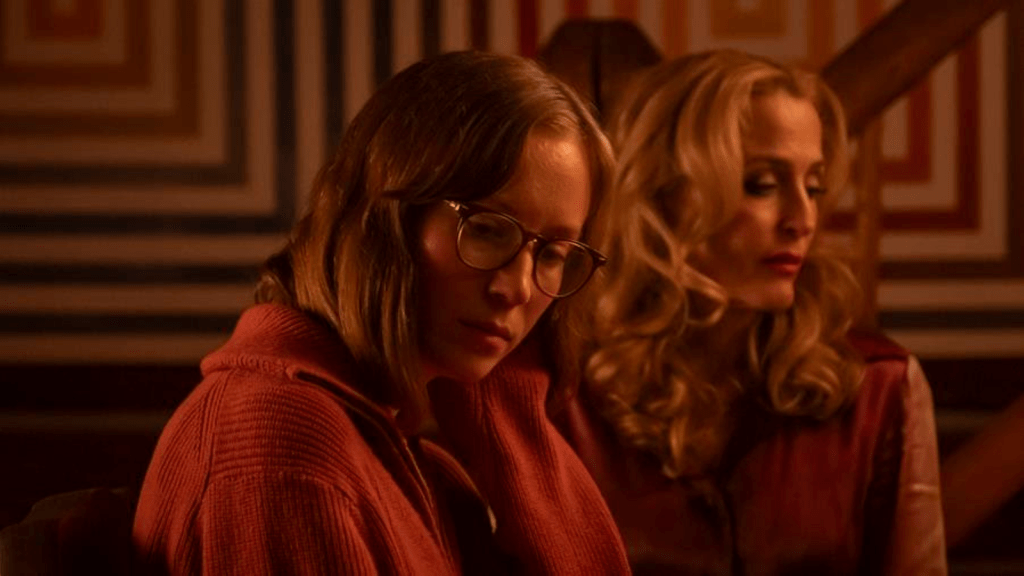
Nowhere in Camp Miasma is this more obvious is in how so much of this is a movie playing within a movie within a movie, as Williams’ encounter with the final girl star of the original film, Billy Presley, slowly itself begins to morph into a psycho-sexual encounter in it’s own right as Williams deconstructs her own relationship with sex. She is clinical, academic, and logical about it, which of course has given her a barrier to the way she views her own relationship with sexuality and her partners. She has to escape somewhere else to find a level of pleasure in her own body, in her own skin. She needs to disassociate.
All of Schoenbrun’s films are about transness in some way, shape, or form, and in Camp Miasma that takes the vein of how so many queer folks have an inherent shame around sex and how they cope with that. Needing to leave your own body in order to actually achieve the brief moment of pleasure before succumbing to a final, biting stabbing. Like that self-actualization, it takes awhile for Camp Miasma to bear fruit both during and after the picture, where it lingers in the back of your mind like a seed planted. It’s impossible to not escape and it always comes back. He always returns for more.
And yet, in the midst of the high concept, deeply introspective work from Schoenbrun here, there is also a killer, almost impossibly entertaining slasher film at the heart of this as well, with buckets of gore and a purposefully kistch but charming 80s aesthetic that just leaps off the screen. The colors pop, particularly the reds, whites, and blues, and there are split diopters galore and snap zooms galore. Schoenbrun understands that to be an intellectual exercise it also has to be an aesthetic one as well, and there is a real love for the slasher genre here in all of it’s trashy glory that you can’t help but fall in love with it the same way that Kris did and is slowly doing again.
That singular uniqueness to the film, which carries both it’s heart on it’s sleeve but also it’s brain and intelligence as it’s main appeal, is what gives Camp Miasma it’s originality. It’s eccentricities, whether it be in the somewhat academic dialogue or the plethora of product placement that almost works as a self-critique of how a work like this needs to get funded, are part of the appeal. It’s at once deeply moving and life affirming in celebrating kink and sex while also melancholic in how it feels mourning the loss of one’s own ability to find pleasure with just themselves; a contradiction that likely will trip up many viewers but those on Schoenbrun’s wavelength will absolutely eat up.
And if any of it bothers you at any point, well, remember that all of it is just play. You can always turn it off.

