By Matthew Moorcroft
Highest Recommendation
- Directed by Lance Oppenheim and Nathan Fielder
- R
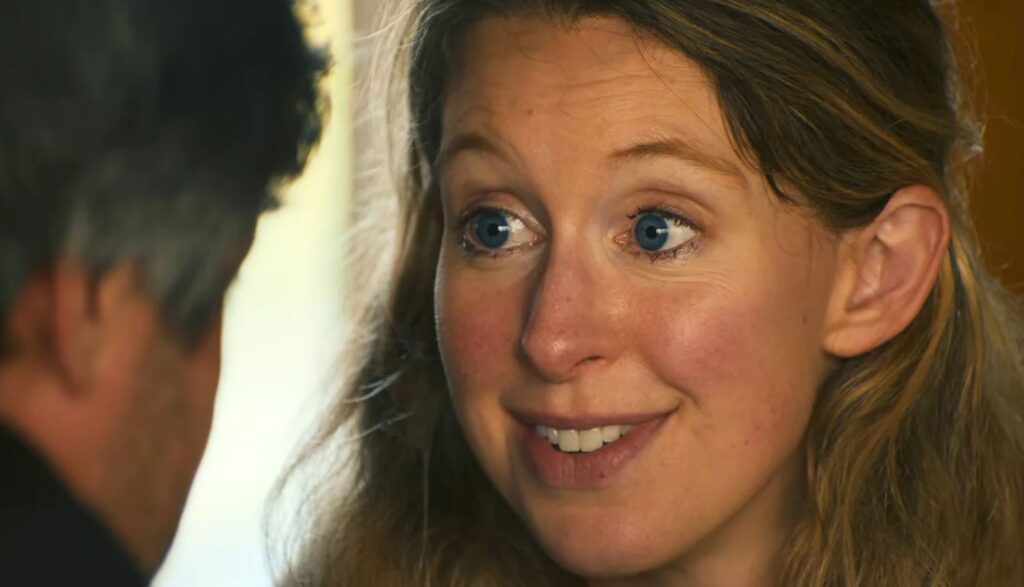
Like all great documentaries, You Can See Everything isn’t actually about it’s titular subject. In this case, that subject is Elizabeth Holmes, the founder of Theranos, in her final days before going to prison for investor fraud. It’s a hell of a premise, filmed in secret without much in the way of knowledge from the general public – hell most people didn’t know the film existed until it’s surprise Telluride premiere – and like Lance Oppenheim’s prior documentaries it has the energy of a snapshot, most observing and recording rather then interfering.
Well, that is until Nathan Fielder gets involved. While Oppenheim has always been keen on letting things play out naturally, Fielder likes to poke and prod until fundamental truths are revealed. And for a subject like Holmes, whose entire existence on the public stage is one where seemingly her entire life was a trick and a lie, it seems perfect for Fielder’s deadpan sarcasm and blunt attitude.
If this were just talking about the first hour of You Can See Everything, which follows this base to a tee, it would already be utterly compelling cinema in it’s own right; Fielder poking and prodding into Holmes’ private life and her feelings and her general attitude towards life and her work with a surprising amount of empathy to the point where you start to at least seemingly understand Holmes despite your instincts telling you not to. But even in that façade, there are cracks in the margins. Stuff that’s clearly not being shown. Days are being skipped, her husband Billy seems weary of the whole thing, and Fielder himself is starting to have his own convictions tested. Despite the claims, it’s difficult to truly “see everything”.
And that’s where You Can See Everything drops it’s own façade and begins to weave into something thornier, more interesting, and ultimately more genuinely unique. It’s difficult to discuss without heading straight into spoiler territory or revealing many of the film’s surprises, but suffice to say is a moment in You Can See Everything where the film transitions from straight documentary into more of a meta-fictional (or meta-nonfictional?) attempt to rationalize the thought processes of mankind. We believe what we wanna believe, and even when the truth is in front of us we still find it hard to find what exactly the “truth” is. But is the “truth” even possible, especially when in a medium like film that is so linked to personal subjectivity and artistry that one’s truth is always going to be warped or changed.
This is where You Can See Everything starts to evolve into a fascinating, self-critiquing portrait of itself, deconstructing the very idea of it’s own premise as it blurs the line between fiction and reality much like Fielder’s work on The Rehearsal or Nathan For You. But it’s through that blurring that those fundamental truths that Fielder is so obsessed with – mainly that of the ever elusive search for the human connection – start to unfold. We see it in how Fielder forms a connection with Holmes in spite of everything, even as Fielder himself begins to doubt his own recollection of events and Holmes’ own opinions and thoughts. We see it in how Billy uses the events of the documentary as a way for his own gain, using his own tactics of manipulation against the filmmakers for his own monetary gain. We even see it in the film itself, which questions the validity of what you are watching after a bomb drop in the second half regarding who is actually going to profit off of the very film you paid a ticket for, leaving you anxious and deeply engrossed in the results.
There really isn’t anything quite like You Can See Everything, and that’s part of the reason why it ultimately transcends being put into the box of either a simple documentary or a docu-drama or even a narrative feature. It’s an endlessly rewatchable – I could have been in that theater for hours more – and deeply rewarding flick that allows for discussion to go past the simple stuff we see on screen. The final moments leave little for objectivity, as you have to put into perspective the subjectivity of it’s own subject front and center in your mind. You never stop thinking while watching it, and watching it in of itself is an act worthy of analysis. Are you here to see Holmes taken down a peg, here for Fielder doing his schthick, or are you willing to see everything?
If, of course, you even can.

