By Matthew Moorcroft
Highest Recommendation
- Directed by Beth de Araujo
- Starring Gemma Chan, Channing Tatum, Mason Revees, Philip Ettinger
- R
CONTENT WARNING: This review contains frank discussions on sexual assault.
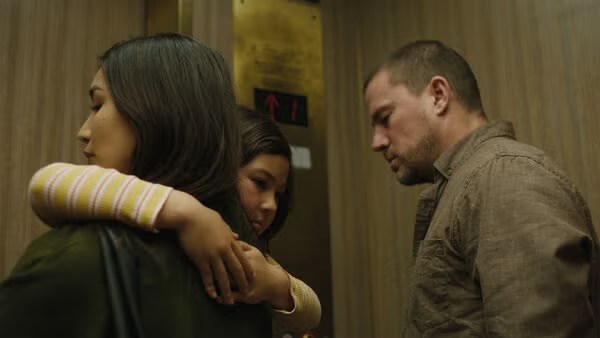
A loss of innocence that comes far too early in the worst possible way, Josephine plays out like a parent’s worst nightmare. A young girl, the titular Josephine, is exposed to an act of horrific violence and depravity in broad daylight – a clear choice from filmmaker Beth de Araujo to highlight the ways we let sexual crimes happen like this under our noses without actually doing anything – and the resulting film is the aftermath of how she, her parents, and the rest of the nearby world react to it. There is very little in the way of anything glamourous or dramatized here; if anything, it plays out almost like a docu-drama with how down to earth it keeps it’s portrayal.
This is crucial for why Josephine is so effective and haunting. Araujo’s frank depiction of the event lingers like a shadow over the entire film to the point where even the specter of the rapist is a character here – almost always in the scene in some way, whether in the background where he’s almost imperceptible or the foreground where he is directly visible and in your face and you can’t escape him. Josephine herself can’t escape it anymore, and her difficult reactions to it are understandable to a viewer who is placed in the mind of a confused child who is way too young to truly get it. Mason Reeves is asked a lot as a performer here and as a child performance, it’s one of the best in a very long time. She feels like a real kid stuck in a place of unfathomable contradictions; smart enough to know something is wrong and wanting to know more, but not mature enough yet to fully grasp the gravity of the situation.
And yet, part of Josephine‘s tragedy is arguably how many of the adults around her fail to properly console her or explain the situation. Her parents are trying their best but the events clearly put strain on their marriage as they have different ways to helping their child. The lawyers and police that come to her aid either ignore her, treat her like baggage, or only really see her as a bigger piece in a court case that they only care to win rather then see actual justice laid out. It’s easy to say that no justice is ever given in the world, but once you see it through the eyes of Josephine you very much start to believe it. Why is it that justice seems ever so far away even when it’s achieved? And is it really justice when, again, this type of crime can happen in broad daylight, a child can watch, and the culprit leaves trauma in his wake?
It’s these difficult questions that permeate Araujo’s searing script, whose grim tone is only matched by the impeccable direction at hand here. It’s smart that Araujo plays this like a thriller, leaving you gripping your seat at even the smallest of noise changes and sudden transitions. Once the court elements seep into the narrative, Araujo plays her hand slowly, letting the court scenes play out with a level of methodical pace that makes you feel like you are, yourself, watching the case play out live. The final long take, which goes on for over 10 minutes and is culmination of all of Araujo’s tricks that have been built up over the course of the picture, is a bravura showcase of performance, cinematography, and blocking on par with that of the masters. Despite being only her second feature, Araujo already is a voice to watch out for with a clear eye for the kind of uncomfortable tension required for a project like this.
Josephine is ultimately a lot to stomach, but there is true compassion in it’s telling and it’s deliberate in it’s pace to the point where nothing feels unjustified or unearned. Chan and Tatum are giving some career best stuff here in the midst of the phenomenal Reeves at the center, and Tatum in particular feels like he’s finally able to sink his teeth into a role with nuance and meat. It’s especially apparent in the final stretch, where Tatum has to go through a gluttony of emotions all at once and it’s suffocating in the way that he manages to realistically portray that breakdown. Those final moments are purposefully ambiguous on the fate of the case itself, but instead feel like a grand moment of catharsis as a young girl, maybe forcibly, grows up and learns to empathize. After all, everyone grows up, but it’s matter of how we do that defines us.

